
Reference / Case study 18 / Banking & financial services
CIC Crédit Mutuel: an innovation workshop that does not stop at the wall of sticky notes
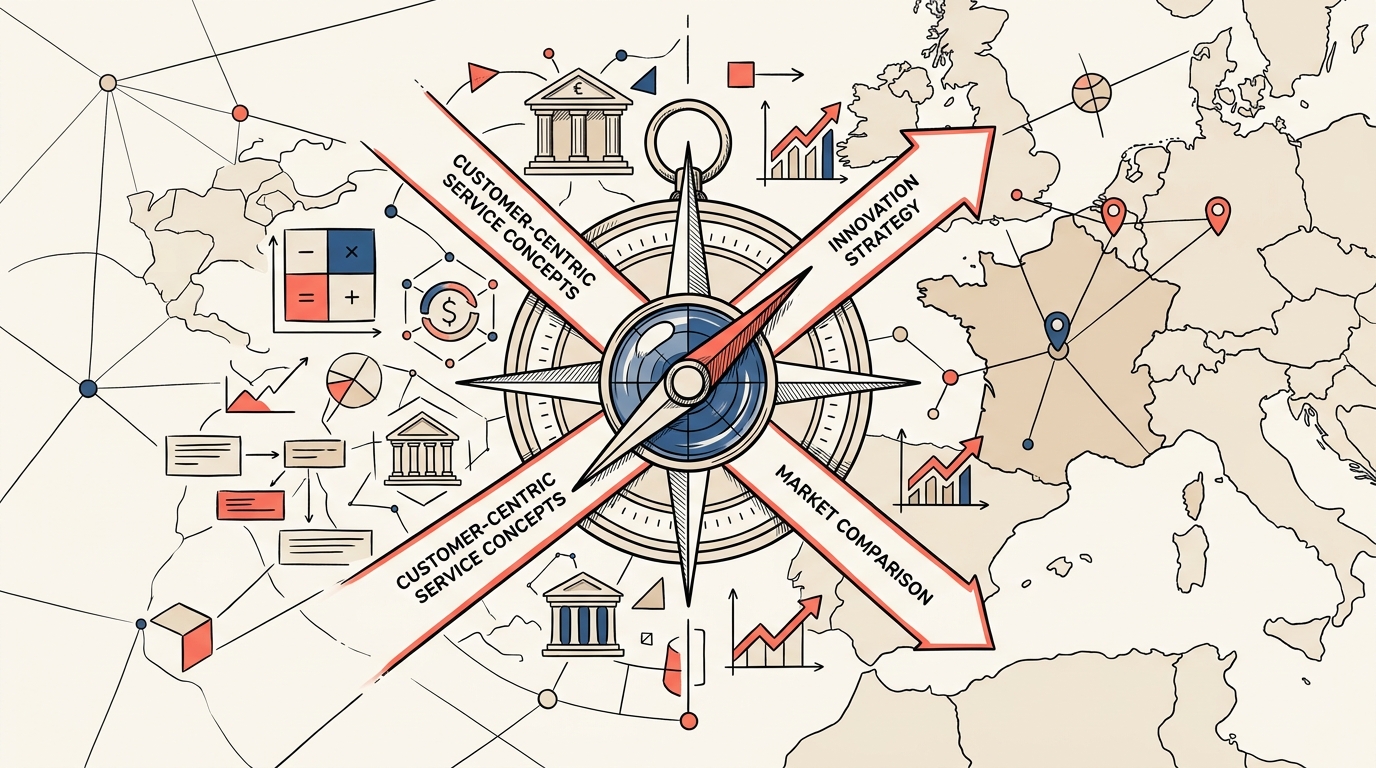
The engagement used a design-thinking workshop for CIC Crédit Mutuel, defining strategic innovation pillars and customer-centric service concepts with a planned testing phase rather than a one-off ideation session.
- Client
- CIC Crédit Mutuel
- Industry group
- Financial Services
- Specific industry
- Banking & Financial Services
- Expertise
- Innovation strategy, concept development, concept testing and workshop
- Market
- France
- Engagement
- Design thinking and service concepts
- Case
- 18
- LED AT
- June Marketing
Context
CIC Crédit Mutuel: an innovation workshop that does not stop at the wall of sticky notes
CIC belongs to Crédit Mutuel Alliance Fédérale, a French mutualist banking group with a large national network. Retail banking is a category where features can be copied quickly, while how a service is delivered is much slower to replicate.
Most innovation workshops fail after the session, not during it. Ideas are abundant and collective energy is genuine, but teams are often left without a way to select, test or carry the work forward.
Here, strategic innovation pillars preceded concept generation and testing was planned from the outset. That sequence changes how a concept is written: it must be understandable without commentary, concrete enough to prompt a reaction and viable beyond ideal workshop conditions.
A workshop is designed from what will happen afterwards, not from what will happen during.
Strategic challenge
The questions that structured the work
Our approach
From analysis to usable decisions
Observe before ideating
Start with the real situations of customers and advisers, not assumed pain points.
Set innovation pillars
Define a small number of bounded exploration spaces before opening up ideation.
Separate divergence and convergence
Produce without judging, then assess using criteria decided before the session.
Write concepts for testing
Make each route comprehensible without spoken commentary and open to improvement.
Test and arbitrate
Confront concepts with customers and frontline teams, then rank by coherence, feasibility and prize.
Research and work conducted
What the engagement covered
- Reading moments of truth in the customer journey through observation.
- Strategic innovation pillars that bounded exploration.
- Customer-centric service concepts written for independent understanding and testing.
- A concept-testing design involving customers and frontline teams.
- A prioritisation frame including coherence, feasibility, regulatory and technical constraints.
- A documented workshop design for team reuse.
Business value
A reading that makes trade-offs easier

Earlier discard
Testing before industrialisation reduces investment in concepts that do not survive contact with reality.
A tighter pipeline
Bounded pillars yield fewer but more mutually reinforcing projects.
Teams remain engaged
A workshop with a real sequel sustains participation in the next exercise.
Harder-to-copy differentiation
The manner of serving customers lasts longer than a copyable product feature.
Deliverables
Objects teams can use beyond the engagement
- Customer-journey observation.
- Strategic innovation pillars.
- Testable service concepts.
- A customer and frontline testing design.
- Prioritisation and feasibility criteria.
- A documented workshop format for reuse.
Key learnings
What this case makes clear
- Knowing a concept will be tested changes how it is written.
- Pillars come before concepts because they prevent dispersion.
- A concept that only works under ideal conditions is a demonstration, not a concept.
- In retail banking, features copy quickly; the manner of serving does not.
- A workshop with no sequel durably demobilises the people who participated.
FAQ
Frequently asked questions
How do you run a design-thinking workshop in banking?
Start with observation and end with testing. The process needs real customer and adviser situations, bounded ideation, concepts that can stand alone, and a test involving those who will use the service.
What is a strategic innovation pillar?
It is a bounded direction of exploration: broad enough to host several concepts, specific enough to prevent scattered output.
Why test a service concept before industrialising it?
A service concept is judged on repeated execution. Testing with customers and frontline teams reveals whether it survives ordinary conditions before development commitments are made.
Why do innovation workshops lead nowhere?
They lack an upstream frame, predefined selection criteria, usable output formats or a follow-up sequence. The issue is often design rather than facilitation.
How do you make a banking service customer-centric?
Observe the moments where experience degrades, including those absent from dashboards, then design for ordinary conditions rather than a perfect pilot.