
Reference / Case study 42 / Travel & infrastructure
VINCI Airports: the passenger did not choose the airport — B2B2C consumer centricity means representing someone who cannot leave
The project focused on designing and delivering a strategic sprint intended to strengthen B2B2C consumer centricity across the teams, together with their ability to defend a recommendation.
- Client
- VINCI Airports
- Industry
- Travel & infrastructure
- Expertise
- B2B2C strategy · Training · Consumer centricity · Pitching
- Subject
- A strategic sprint to build team capability
- Geography
- Europe, Asia, Americas
- Nature of the engagement
- Design and delivery of a strategic sprint to strengthen B2B2C consumer centricity and pitching capability
- Consultant
- Aurélie Plessier
- Case no.
- 42
- LED AT
- Labbrand
Context
VINCI Airports: the passenger did not choose the airport — B2B2C consumer centricity means representing someone who cannot leave
The context is documented: VINCI Airports operates more than 70 airports in 14 countries and welcomed more than 334 million passengers in 2025, growth of around 5% year on year, making it the world's leading private airport operator.
The difficulty specific to this model lies in the passenger's position. The company's customers are airlines, retailers, concession holders and public authorities; the passenger is nobody's customer within the contractual chain, and did not choose the airport they are standing in. Being consumer centric in B2B2C therefore means representing someone who is not in the room and who cannot leave. Hence the second half of the brief: being right is not enough, you have to be able to argue it. The conclusions and the client's proprietary data are not disclosed.
A network, not a site: VINCI Airports operates more than 70 airports across 14 countries and welcomed more than 334 million passengers in 2025, some 16 million additional travellers in a year. It is the world's leading private airport operator.
That scale has a direct methodological consequence: an intercontinental hub, a regional airport and an island stopover serve neither the same journeys nor the same states of mind. A shared approach cannot therefore be a uniform standard, but a way of reasoning that transfers.
A value chain where the passenger is nobody's customer: An operator's revenue comes from airlines, retail and concessions, car parks and services. The passenger crosses that whole system without being party to any contract. They are the one who lives the experience and the one nobody bills directly.
A user in a constrained state: An airport is one of the few places where the user is simultaneously rushed, monitored, loaded with bags, often anxious about missing something, and without an alternative. Conventional listening mechanisms work poorly in that state: satisfaction stated afterwards does not describe what happened during.
Representing someone who is not in the negotiation: The likely challenge was to install a capability: carrying the passenger's point of view into discussions where every other party is represented by someone who pays. Without that capability, the final experience is decided by default, as the residue of commercial trade-offs.
The absence of immediate sanction: In ordinary retail, an unhappy customer leaves. Here they board anyway. The absence of sanction removes the usual signal and makes active observation of what the passenger actually experiences necessary.
Why pitching is part of the subject: The second half of the brief follows logically from the first. An argument grounded in passenger experience runs against quantified arguments carried by parties who fund the operation. Being right is therefore not enough: a recommendation has to be defensible in front of people whose immediate interest differs.
A short format, deliberately: The sprint imposes a time constraint that is also a method. It forces production of a defensible deliverable rather than a complete analysis, which matches the teams' real situation.
Teams spread across three continents: Europe, Asia, the Americas: regulatory contexts, travel habits and service expectations differ. The sprint had to produce transferable reasoning rather than a localised recommendation.
The sprint was framed around questions of this kind:
The passenger did not choose this airport and cannot walk out of it. They are a captive user: they vote neither with their feet nor with their wallet.

Strategic challenge
The questions that structured the work
Our approach
From analysis to usable decisions
Reconstruct the real journey
Describe the passenger's path as successive events and states, not as functional zones. A floor plan describes a building; a journey describes an experience.
Identify the empty seat
Establish who represents each party in the decision forums, and note who is not represented. It is the fastest way to make the problem concrete.
Translate experience into partner language
Restate a passenger issue in the terms that matter to a retailer, an airline or a public authority. An untranslated argument is not heard.
Have people pitch, then push back
Have every recommendation defended against real objections, played by the participants. That exercise is what separates a conviction from a preference.
Extract the transferable reasoning
Separate what holds for one airport from what holds everywhere, so that the sprint serves beyond the case treated.
Research and work conducted
What the engagement covered
- The minute-by-minute journey question is the most productive. It turns an abstract subject — experience — into a series of observable and therefore debatable events.
- The approach applied rests on one principle: in B2B2C, the capability to install is that of an advocate, not that of an analyst.
- A captive user: The absence of an alternative removes the usual commercial signal. Dissatisfaction translates into neither lost traffic nor departure.
- Legitimately divergent interests: Airlines, retailers and public authorities have their own defensible objectives. The passenger is not opposed to them, but is represented by none of them.
- An emotional state that is hard to document: Rushed, monitored, loaded: the passenger's state shapes all their behaviour and is poorly measured after the fact.
- Non-negotiable constraints: Security, customs, border control: part of the journey cannot be changed. Recommendations have to address what surrounds it.
- The heterogeneity of the network: More than 70 airports in 14 countries: too specific a recommendation does not transfer, too general a one applies nowhere.
- The short time of a sprint: The format rules out exhaustiveness. That is an accepted constraint, but it demands strict discipline in choosing the subjects treated.
Business value
A reading that makes trade-offs easier
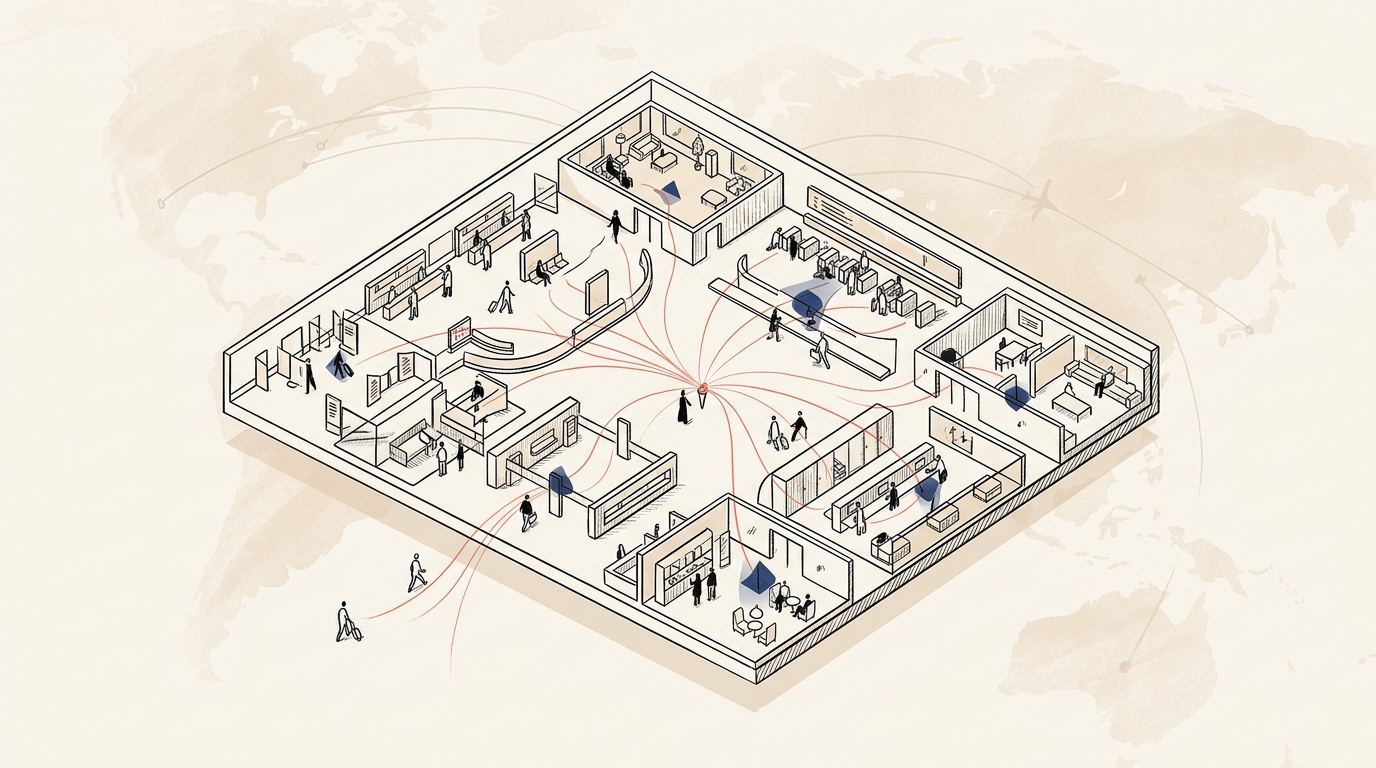
An experience decided rather than inherited
Taking the empty seat prevents the final experience from being the unintended residue of commercial trade-offs.
Recommendations that get through
Translating a passenger issue into partner terms raises adoption far more than analytical quality does.
A transferable capability
The reasoning applies to other airports in the network without a further engagement.
An effect on commercial revenue
A less rushed, less anxious passenger has different available time, which concerns commercial partners directly.
Deliverables
Objects teams can use beyond the engagement
- A reconstruction of the passenger journey as successive events and states.
- A map of the parties represented in decisions, and of the empty seat.
- A method for translating a passenger issue into commercial partner language.
- Recommendations defended and challenged in session.
- A short pitch format, usable in real decision forums.
- The distinction between transferable reasoning and elements specific to one airport.
Key learnings
What this case makes clear
- In B2B2C, the end user is represented by nobody in the room: consumer centricity means taking that empty seat.
- A captive user produces no commercial signal: the absence of complaint is not evidence of satisfaction.
- A floor plan describes a building, a journey describes an experience.
- An argument not translated into the listener's terms is inaudible, not merely weak.
- Being right is not enough: the ability to defend a recommendation is part of the capability.
- Across an international network, what transfers is the reasoning, not the recommendation.
FAQ
Frequently asked questions
What is consumer centricity in B2B2C?
It is the capability of representing the end user in decisions where every other party is represented by someone who pays. In a B2B2C model the contractual customers are businesses; the user who actually lives the experience is party to no contract and has nobody carrying their point of view. Consumer centricity means taking that empty seat, failing which the final experience is decided by default, as the residue of commercial trade-offs.
How do you argue for the end user with a paying client?
By translating the issue into the terms that matter to the listener. An argument grounded in experience runs against quantified arguments carried by those who fund the operation; stated in its own vocabulary it remains inaudible. The approach is to restate what the user experiences as concrete effects for the partner — available time, flow, complaints, footfall — then to practise defending the recommendation against real objections.
How do you improve the experience of a captive user?
By observing actively, since the usual signal is missing. A user with no alternative does not leave: the absence of complaint therefore proves nothing. Their journey has to be reconstructed as successive events and states rather than as functional zones, the moments where their state changes have to be identified, and decisions taken for other reasons that produce an unintended effect on that journey have to be surfaced.
How do you design a corporate strategic sprint?
By accepting that the format rules out exhaustiveness and making that constraint the method. A sprint forces production of a defensible deliverable rather than a complete analysis, which matches the teams' real situation. Design therefore consists of choosing the subjects strictly, devoting most of the time to production, and reserving a sequence for testing conclusions through challenge.
Why learn to pitch a recommendation?
Because in a model where the end user is not the payer, a recommendation's adoption rate depends more on how it is framed than on its analytical quality. A good analysis that is rejected produces no effect. Having each recommendation defended in session, against real objections played by the participants, is also the exercise that separates a reasoned conviction from a personal preference.