
Reference / Case study 31 / Beauty & luxury
Valentino Beauty: an archetype travels, its expression never does
The project covered supporting the definition of the female archetypes capable of resonating across both China and the United States for Valentino Beauty, in order to contribute to a shared brand purpose and a global strategic direction.
- Client
- Valentino Beauty
- Industry
- Beauty & luxury
- Expertise
- Brand archetypes · Cultural insight · Global brand strategy
- Object
- Definition of female archetypes and contribution to a shared brand purpose
- Markets studied
- China · United States
- Geography
- Americas · Asia · Europe
- Engagement type
- Defining archetypes capable of resonating across two markets and supporting global strategic direction
- Consultant
- Aurélie Plessier
- Case No.
- 31
- LED AT
- Brainvalue
Context
Valentino Beauty: an archetype travels, its expression never does
Archetypes are often presented as universal. That is true of their structure and false of their expression. The figure of the woman who seduces, who protects, who refuses, who creates exists in almost every culture — but what counts as seduction, protection, refusal or creation varies profoundly.
Working across two markets as different as China and the United States therefore demands a rigorous distinction: what in an archetype constitutes a stable core, and what belongs to a culturally situated expression. Confusing the two produces either a universal and bland figure, or two unconnected brands. Conclusions and proprietary client data are not disclosed.
A couture house in beauty: Valentino Beauty belongs to the world of an Italian couture house whose identity rests on a recognisable aesthetic and on a particular relationship to colour, gesture and presence.
As in most luxury houses, the beauty category performs a specific function: it is often the first purchase, the accessible entry into a world whose other products are not. It therefore has to be faithful to the House and legible to a wider audience, which requires a clear definition of what the brand says about those who wear it.
Two markets that do not tell the same story: China and the United States are among the most decisive markets in luxury beauty, and among the most different. Collective narratives about female success, self-expression, the relationship to others' gaze, the place of family and how ambition is publicly voiced do not follow the same paths.
That difference is not a question of market maturity or speed of change. These are two distinct trajectories, and treating them as two stages of one path is the most frequent error in global strategies.
What an archetype is, and what it is not: A brand archetype designates a recognisable figure that organises a brand's narrative and gives coherence to its expressions. It is neither a target nor a consumer portrait: it is a role, a stance, a way of being in the world that the brand proposes.
Its strength lies in its stability: a well-chosen archetype survives campaigns, collections and changes of team. Its fragility lies in its expression: the signals that make it recognisable are entirely cultural.
The two possible failures: Two outcomes await multi-market archetype work, and they are symmetrical. The first is universalisation: choosing a figure so broad that it suits everywhere and commits nowhere — the strong, free, authentic woman that dozens of brands already claim. The second is fragmentation: each market retains its own figure, and the House loses all global coherence.
The workable way through: The likely strategic challenge was therefore to separate two levels explicitly. The archetype's core — the tension it carries, the role it plays — must be stable and shared. Its expression — the signals, situations, tone, visual references — must be local and owned as such.
That distinction makes possible what the engagement aimed at: a shared brand purpose that is neither a lowest common denominator nor an instruction from headquarters.
The sensitivity of the subject: Working on representations of femininity involves more than a brand exercise. A poorly chosen figure does not merely produce commercial inefficiency: it can reproduce stereotypes the public contests, and exposure is immediate. That responsibility has to be present at the framing stage, not added at review.
The work was framed around questions of this kind:
The same female figure can read as an affirmation in one country and as a provocation in another. It is not the archetype that changes, but what it costs to embody it.
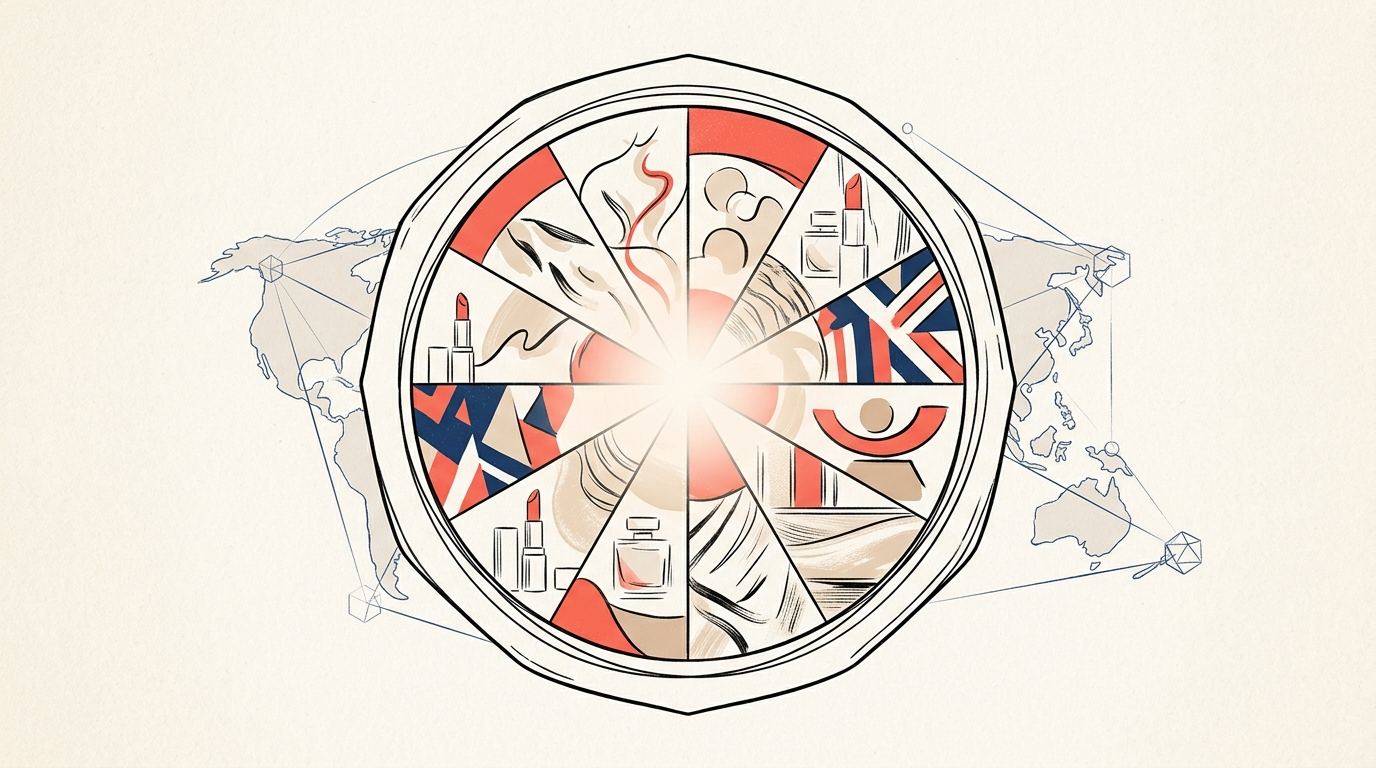
Strategic challenge
The questions that structured the work
Our approach
From analysis to usable decisions
Observe real figures before advertising ones
Gather the representations circulating in the culture — narratives, role models, conversations — rather than those already staged by the category. The latter mirror the industry, not society.
Identify the tension rather than the portrait
Look for what creates tension in each figure: between freedom and belonging, affirmation and discretion, desire and control. An archetype without tension is only a flattering portrait.
Separate core from expression
Explicitly distinguish what stays identical across the two markets — the role, the tension — from what must vary: signals, situations, tone, references.
Test competitive occupation by market
Check that an archetype is not already occupied by a competitor in one of the two markets. A figure free in the United States may be saturated in China, and vice versa.
Derive the purpose, do not precede it
Formulate the brand purpose from the chosen archetype rather than the reverse. A purpose written first almost always produces a formula any brand could sign.
Research and work conducted
What the engagement covered
- The third question is the most revealing. The social cost of a stance varies enormously between cultures, and it is that cost, more than the stance itself, that determines its reach.
- The approach rests on one principle: an archetype is chosen on its core and adapted on its expression, never the reverse.
- Surface universalism: The temptation of a figure valid everywhere produces a formulation dozens of brands already claim. Universality achieved by widening is not universality; it is blandness.
- The advertising mirror: The most visible female figures are those the category stages. Mistaking them for cultural reality means observing the industry rather than society.
- Asymmetry of trajectories: Treating two cultures as two stages of one path leads to framing errors. These are distinct trajectories, not different speeds.
- The responsibility of representation: Choosing a female figure commits more than commercial effectiveness. A dated or stereotyped representation exposes the brand immediately, and differences in sensitivity between markets complicate the exercise further.
- Differentiated competitive saturation: An archetype available in one market may be occupied in the other. Verification has to be done market by market, without assuming the competitive landscape is similar.
- Translation into signals: A sound archetype poorly translated visually does not work. Moving from figure to concrete signals — situations, gestures, colours, casting — is where most archetype work is lost.
Business value
A reading that makes trade-offs easier
Global coherence without uniformity
Separating core from expression allows a House to remain itself across two very different markets without imposing identical execution. It is the only way to hold a global direction that is locally applicable.
Real differentiation
Checking competitive occupation market by market avoids retaining a figure already saturated, which happens frequently when verification is done only on the lead market.
A sharper creative starting point
An archetype expressed through its tension gives creative teams usable material, where a flattering portrait produces only conventional imagery.
Managed exposure
Making explicit the representations set aside, and the reasons for it, protects the brand and eases later trade-offs.
Deliverables
Objects teams can use beyond the engagement
- A reading of the female figures genuinely present in each culture, distinguished from advertising representations.
- An identification of the tensions those figures carry.
- A definition of the archetypes retained, expressed by their core rather than by their portrait.
- An explicit separation between what stays stable across markets and what must vary.
- A map of competitive occupation of archetypes, market by market.
- A contribution to the formulation of a brand purpose derived from the archetype.
- Translation principles into signals for each market.
- An explicit statement of the representations set aside and the reasons for their exclusion.
Key learnings
What this case makes clear
- An archetype travels through its structure, never through its expression. Confusing the two produces a bland figure or two unconnected brands.
- A figure broad enough to suit everywhere has generally already been claimed by every competitor.
- What counts as self-affirmation varies between cultures, and it is its social cost that determines its reach.
- The most visible female figures are those advertising stages: mistaking them for culture means observing the industry.
- An archetype without tension is only a flattering portrait.
- Brand purpose is derived from the archetype. Written first, it produces an interchangeable formula.
FAQ
Frequently asked questions
What is a brand archetype and what is it for?
An archetype designates a recognisable figure that organises a brand's narrative and gives coherence to its successive expressions. It is neither a target nor a consumer portrait: it is a role, a stance, a way of being in the world that the brand proposes. Its value lies in its stability — a well-chosen archetype survives campaigns, collections and changes of team — and in its capacity to give creative teams a richer starting point than a list of attributes.
Are archetypes universal or cultural?
Both, but not at the same level. An archetype's structure travels: the figure of the woman who seduces, who protects, who refuses exists in almost every culture. Its expression, by contrast, is entirely cultural: what counts as seduction, protection or refusal varies profoundly, as does the social cost of embodying that stance. The method is therefore to separate explicitly the core, which stays stable across markets, from the expression, which must vary and be owned as local.
How do you define a brand purpose valid across several markets?
By deriving it from the archetype rather than writing it first. A purpose formulated upstream almost always produces a sentence any brand in the sector could sign, because it is built to offend no market. Derived from an archetype carrying an identified tension, it inherits that tension and becomes specific. The test is simple: if a competitor could claim the same purpose unchanged, it is not one.
How is femininity represented differently across markets?
Through what it costs rather than what it is. The major figures — affirmation, seduction, control, care — recur everywhere, but the social price of embodying them publicly varies sharply by context, as does how ambition, desire or independence can be voiced. Treating those differences as gaps in maturity is the classic error of global strategies: these are distinct trajectories, not different speeds along one path.
How do you build a global strategic direction in beauty?
By explicitly stating what stays identical everywhere and what must vary, then documenting it. What stays identical belongs to the core: the archetype, the tension it carries, the purpose derived from it. What varies belongs to expression: situations, signals, casting, tone, visual references. Without that separation, a global direction becomes either an instruction from headquarters that markets work around, or a lowest common denominator nobody defends.