Reference / Case study 36 / Wine & spirits
Pernod Ricard: in spirits, the same person drinks several of your brands in one evening
The project focused on portfolio architecture work in spirits, with the aim of clarifying the role of each brand within the whole.
- Client
- Pernod Ricard
- Industry
- Wine & spirits
- Expertise
- Brand architecture · Portfolio strategy · Segmentation
- Subject
- The role of each brand within the portfolio
- Geography
- International
- Nature of the engagement
- Portfolio architecture work based on consumption occasions
- Consultant
- Aurélie Plessier
- Case no.
- 36
- LED AT
- June Marketing
Context
Pernod Ricard: in spirits, the same person drinks several of your brands in one evening
Spirits have a characteristic few other categories share: the same person consumes several brands from the same portfolio over a single evening. An aperitif, a cocktail and a digestif may belong to three brands owned by the same group. Segmentation by target, which assumes one consumer per brand, therefore describes reality poorly.
The analysis explored segmentation by occasion: the relevant unit is not the person but the moment. The architecture question then becomes 'which moment does each brand own?' rather than 'who is each brand speaking to?'. The conclusions, portfolio decisions and the client's proprietary data are not disclosed.
A portfolio that is broad by construction: The major spirits players hold portfolios spanning several categories — whisky, gin, vodka, rum, anise, liqueurs, champagne — and several price tiers within each. That breadth is a direct consequence of how the sector grows, largely through acquisition.
It produces a specific architecture difficulty: the brands were not designed together. Each arrived with its own history, territory and legitimacy, and the whole nonetheless has to be steered as a coherent portfolio.
A consumer who belongs to no brand: In most consumer categories, brand loyalty is a useful indicator. In spirits it describes behaviour poorly: one person's repertoire contains several brands, often across several categories, and the choice is made at the moment, not in advance.
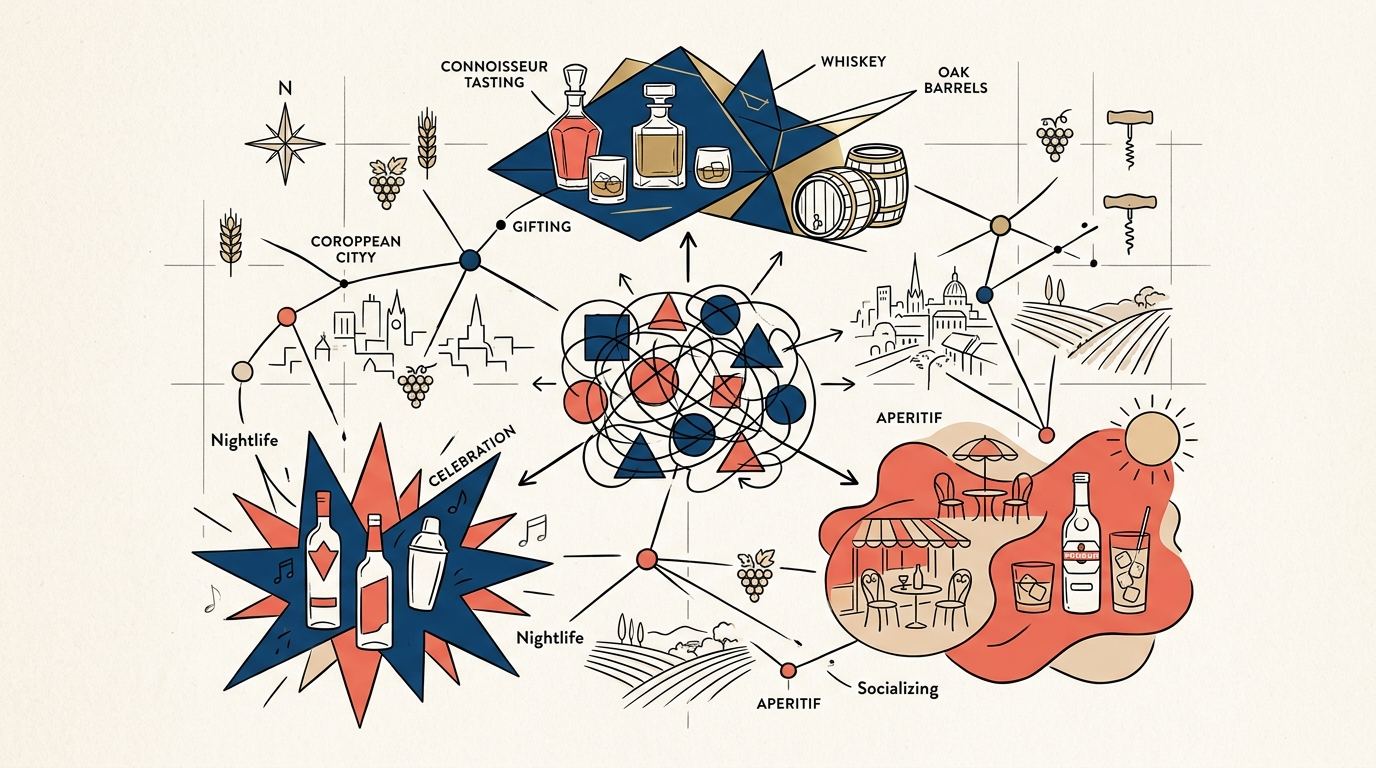
The moment structures the category: The aperitif, the meal, the night out, the bar, the home, the celebration, the gift: each of these moments has its codes, its acceptable strength, its serve, its implicit price. Those differences discriminate more than age, income or lifestyle.
Assigning a role to each brand: The likely strategic challenge was to define what each brand contributes to the whole: which territory it occupies, what it makes possible and what it must not do. Without that clarification, a broad portfolio mechanically produces overlaps.
The internal cannibalisation problem: When two brands from the same group target the same occasion at the same price, they genuinely compete, but that competition is invisible in the metrics because each is steered separately. Architecture exists precisely to make the overlap visible before it costs.
Target-based segmentation does not operate here: Segmenting by profile assumes a stable correspondence between a person and a brand. In spirits that correspondence does not exist. Target segmentation then produces plausible portraits that support no decision.
A constraining regulatory frame: Communication on alcoholic drinks is regulated, to varying degrees by market — restrictions on content, media, timing, mandatory statements. A brand territory has to be expressible within that frame to have practical value.
Brands that were not designed together: Architecture is not drawn on a blank page. It has to work with heritage brands, acquisitions and teams attached to their own reading of their brand.
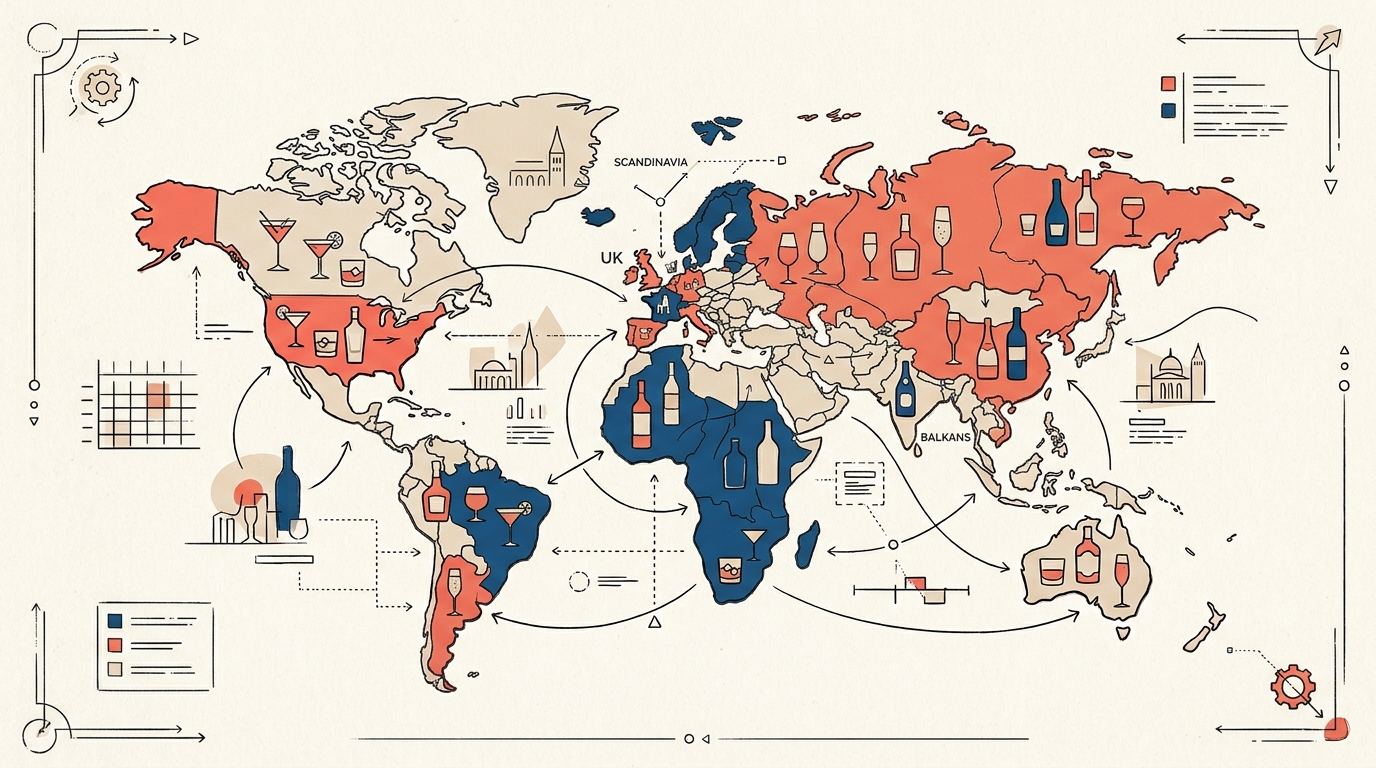
The work was framed around questions of this kind:
In spirits, the same person may drink three of your brands in one evening. Target-based segmentation then assigns three different consumers to a single person.
Strategic challenge
The questions that structured the work
Our approach
From analysis to usable decisions
Establish the occasion map
Describe the genuinely distinct consumption moments: place, hour, company, ritual, serve, implicit price. An occasion is only distinct if one of those parameters changes the choice.
Place the brands on that map
Position each brand where it is spontaneously chosen, not where it would like to be. The gap between the two is itself architecture information.
Make the overlaps visible
Identify occasions covered by several brands at the same price level. That is where internal cannibalisation sits, invisible as long as each brand is steered separately.
Look for vacant occasions
Identify the moments the portfolio does not cover. They constitute the safest growth space, because they do not require taking share from a group brand.
Translate into workable roles
State for each brand what it owns, what it can extend into and what it must not do, in terms teams can use and that can be expressed within the regulatory frame.
Research and work conducted
What the engagement covered
- The question of uncovered occasions is often the most productive: it identifies growth space that a target-based reading does not reveal.
- The approach applied rests on one principle: in spirits, the unit of segmentation is the moment, not the person.
- Invisible cannibalisation: Two brands from the same group competing for the same occasion produce a real loss that brand-level metrics do not reveal.
- Teams' attachment to their brand: Architecture work involves telling a team what its brand must not do. That is the hardest part of the exercise, and the part that determines whether it is actually applied.
- Brands of different origins: Portfolios built through acquisition assemble brands with heterogeneous histories and legitimacies. A uniform framework describes them poorly.
- Occasions vary by market: The same moment does not exist everywhere: the aperitif, the digestif and the after-dinner cocktail do not hold the same status across cultures. An occasion map is not transferable as is.
- The regulatory frame: Communication restrictions vary sharply between markets. A territory that is workable in one country may be inexpressible in another.
- The temptation of blanket premiumisation: Not every occasion carries a trade-up. Applying the same price trajectory across a portfolio ignores what the moment permits.
Business value
A reading that makes trade-offs easier
Less internal competition
Making overlaps visible allows them to be arbitrated rather than funded twice.
Better-identified growth space
Vacant occasions offer growth that is not taken from another group brand: the most profitable form of growth for a broad portfolio.
Better-framed innovation decisions
Knowing which moment a brand owns indicates which extensions are credible and which would move it off its territory.
A finer pricing policy
Acceptable price depends on the moment more than on the brand. An occasion-based reading avoids applying a uniform trajectory to situations that will not carry it.
Deliverables
Objects teams can use beyond the engagement
- A map of the genuinely distinct consumption occasions in the markets considered.
- The position of each brand on that map, as observed rather than as claimed.
- An identification of internal overlaps and vacant occasions.
- A definition of each brand's role: what it owns, what it can extend into, what it must not do.
- The implications for innovation, pricing and portfolio coverage.
- A formulation compatible with the applicable regulatory frames.
Key learnings
What this case makes clear
- In spirits, the same person consumes several brands from the same portfolio: the target is not a useful unit of segmentation.
- The right architecture question is 'which moment does this brand own?'.
- An occasion is only distinct if one of its parameters actually changes the choice.
- Internal cannibalisation is invisible as long as each brand is steered separately.
- Vacant occasions offer the least costly growth, because it is not taken from the group.
- Acceptable price depends on the moment more than on the brand: premiumisation does not apply uniformly.
FAQ
Frequently asked questions
How do you segment a spirits portfolio?
By occasion rather than by target. In this category the same person consumes several brands from the same portfolio, sometimes over a single evening: an aperitif, a cocktail, a digestif. Segmenting by profile then assigns several different consumers to a single person and supports no decision. Occasion-based segmentation takes the moment as its unit — place, hour, company, ritual, implicit price — because that is where the choice is actually made.
Why segment by occasion rather than by target?
Because target segmentation assumes a stable correspondence between a person and a brand, and that correspondence does not exist in repertoire categories. The moment, by contrast, discriminates: it determines the acceptable strength, the serve, the implicit price and the expected codes. Segmenting by occasion produces workable decisions — which brand to extend, where not to go, which space is vacant — where profile segmentation mostly produces portraits.
How do you avoid cannibalisation between your own brands?
By making overlaps visible before they cost. Two brands from the same group targeting the same occasion at the same price take share from each other, but because each is steered separately the loss appears in no metric. The work consists of mapping the occasions, placing the brands where they are actually chosen, then assigning each an explicit role that includes what it must not do.
What is a consumption occasion in spirits?
It is a moment defined by a place, an hour, company, a ritual, a serve and an implicit price: the aperitif with colleagues, the cocktail at the bar, the late-evening drink, the bottle given as a gift. The validity test is simple: an occasion is only distinct if one of its parameters actually changes the person's choice. Otherwise it is not an occasion but a descriptive nuance with no decision value.
How do you define the role of each brand in a portfolio?
By stating three things for each: what it owns today, what it can legitimately extend into, and what it must not do. The third is the hardest to get accepted and the most decisive: without it, architecture remains description and overlaps persist. These roles must be expressed in terms operational teams can use and that can be voiced within the regulatory frame of the market concerned.