
Reference / Case study 39 / Food & confectionery
Parle G: modernising a brand whose principal asset is that it has not changed
The project focused on brand work around a very widely distributed biscuit in the Indian market.
- Client
- Parle G (Parle Products)
- Industry
- Food & biscuits
- Expertise
- Brand strategy · Brand heritage · Positioning
- Category
- Glucose biscuits
- Geography
- India
- Nature of the engagement
- Brand work on a very widely distributed biscuit
- Consultant
- Aurélie Plessier
- Case no.
- 39
- LED AT
- Grey Mumbai
Context
Parle G: modernising a brand whose principal asset is that it has not changed
The category context is documented and it illuminates the difficulty. Parle G holds around 40% of India's organised biscuit market and up to almost 70% of the glucose biscuit segment; the gap between its volume share, of the order of 40%, and its value share, of the order of 30%, quantifies the tension precisely. The maximum retail price stayed at four rupees from 1994 to 2021, when it moved to five rupees: the brand absorbed twenty-seven years of inflation through grammage rather than through the ticket price. It is distributed across more than six million retail outlets and exported to more than a hundred countries.
The likely challenge is therefore paradoxical: modernising a brand whose principal asset is precisely that it has not changed. Any trade-up risks breaking the accessibility compact that underpins its status, and inaction lets the volume-value gap widen. The conclusions and the client's proprietary data are not disclosed.
A rare market position: Parle G occupies a position few brands reach, in any category. It accounts for around 40% of India's organised biscuit market and up to almost 70% of the glucose biscuit segment, within an Indian biscuit, cookie and cracker market valued at roughly Rs 1.16 lakh crore in 2025.
Its reach rests on distribution: more than six million retail outlets, including rural areas where neighbourhood retail remains the dominant channel, and an export presence in more than a hundred countries.
A price that has become a reference point: The most revealing fact in the file is the price. The maximum retail price of the entry format stayed at four rupees from 1994 to 2021, before moving to five. For twenty-seven years, inflation was absorbed through grammage and cost rather than through the ticket price.
The volume-value gap: Around 40% of volume for around 30% of value: that gap quantifies exactly the question put to the brand. It is not an execution failure, it is the direct consequence of the model that produced the leadership position.
An asset that is also a constraint: The brand's strength lies in its constancy: same pack, same perceived price, same product, across generations. That constancy is what produces the attachment, and it is also what makes any evolution risky. Changing what has not changed means touching the very reason for the preference.
Premiumisation as a false answer: The usual answer to a volume-value gap is to trade up. On a brand whose status rests on accessibility, that trajectory carries a particular risk: it calls into question the implicit compact with consumers for whom price is not an argument but a condition of access.
Modernising through meaning rather than price: The analysis explored a different route: changing what the brand means rather than what it costs. A brand of this reach carries a cultural charge — the first after-school snack, the classroom, tea, the train, home — that can be worked without touching product or price.
The public evidence available points the same way: the brand recorded a notable rise in digital engagement in 2024, driven by storytelling grounded in shared memory. That suggests heritage can be activated as contemporary material rather than preserved as an archive.
Added value to be found outside the unit price: If the entry format's price is an untouchable reference point, value has to come from elsewhere: additional formats, new occasions, different channels, uncovered uses — without ever removing from the range the format that underpins accessibility.
A permanent cost constraint: A model built on a stable price and mass distribution leaves narrow room for manoeuvre. Every proposal has to fit within that industrial and logistical constraint.
The work was framed around questions of this kind:
When a price has not moved for twenty-seven years, it is no longer a price: it is a reference point. Changing it does not cost margin, it costs meaning.
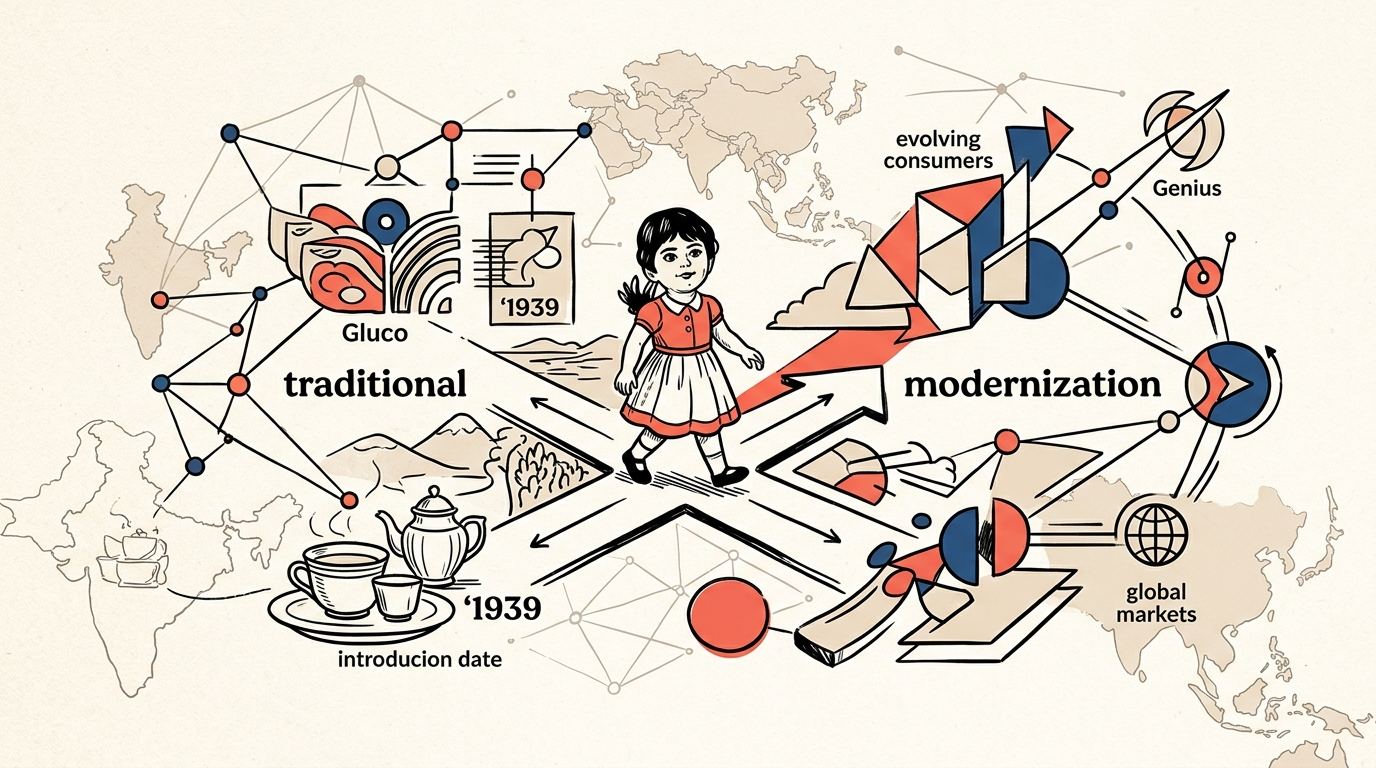
Strategic challenge
The questions that structured the work
Our approach
From analysis to usable decisions
Establish the untouchable core
Identify the elements — perceived price, pack, product, name — whose modification would destroy value. That written perimeter protects the rest of the work.
Break down the volume-value gap
Separate the structural part, tied to the model that produced the leadership, from the addressable part, tied to uncovered occasions or formats.
Look for value outside the accessibility format
Explore formats, occasions and channels that create value without removing from the range the product that underpins the brand's status.
Treat heritage as living material
Use shared memory as contemporary material rather than as archive. An old brand modernises through what it says, not through what it costs.
Check feasibility within the cost constraint
Test every route against the industrial and logistical reality of a stable-price, mass-distribution model.
Research and work conducted
What the engagement covered
- The first question protects all the others. On a heritage brand, explicitly defining what is untouchable is the condition for being able to change everything else without fear.
- The approach applied rests on one principle: on a heritage brand, start by writing down what will not change.
- A price that has become symbolic: Twenty-seven years of stability turned a price into a reference point. Changing it costs more in meaning than it gains in margin.
- A structural volume-value gap: The gap is not an execution failure but a consequence of the model. It cannot be closed without touching what produces the position.
- The risk of premiumisation: Trading up would move the brand out of reach of part of its base, for whom price is a condition of access.
- Nostalgia as a trap: A very old brand can freeze inside its own story. Heritage then becomes an obstacle rather than a resource.
- Very extensive distribution: More than six million outlets, reaching rural areas: any pack or format change commits considerable logistics.
- A permanent cost constraint: A stable-price model leaves little margin to fund an evolution, which calls for frugal solutions.
Business value
A reading that makes trade-offs easier
Protecting what produces the position
Explicitly defining the untouchable core prevents a well-intentioned initiative from damaging the principal asset.
Opening value without a break
Looking for value in formats, occasions and channels narrows the volume-value gap without calling accessibility into question.
Reactivating heritage
Treating shared memory as contemporary material gives an old brand relevance with generations who did not experience it the same way.
Safer decisions
On a brand of this reach, most of the work consists of ruling out bad ideas: that is where the value of explicit framing lies.
Deliverables
Objects teams can use beyond the engagement
- A written perimeter of the brand's untouchable elements.
- A breakdown of the gap between volume share and value share.
- A map of covered and uncovered consumption occasions.
- Value-creation routes outside the accessibility format.
- A reading of brand heritage as contemporary material.
- A feasibility filter accounting for the cost and distribution constraint.
Key learnings
What this case makes clear
- On a heritage brand, the first deliverable is the written list of what will not change.
- A price stable for decades is no longer a price: it is a reference point, and changing it costs meaning.
- A gap between volume share and value share can be structural, and therefore not closable without a break.
- On an accessibility brand, premiumisation moves the brand out of reach of its base.
- Heritage can be contemporary material or an obstacle: how it is activated decides which.
- Very extensive distribution turns any pack change into a major logistical project.
FAQ
Frequently asked questions
How do you modernise a mass brand without betraying it?
By starting with what will not change. On a brand whose principal asset is constancy, the first useful deliverable is an explicit perimeter of untouchable elements — perceived price, pack, product, name. That framing protects the asset and then frees everything else: occasions, complementary formats, channels, storytelling. Modernisation then runs through what the brand means rather than through what it costs or what it physically is.
Why is a volume leader not a value leader?
Because the accessibility that produces the volume mechanically limits unit value. Parle G offers a quantified illustration: around 40% volume share for around 30% value share. That gap is not an execution failure but the direct consequence of the model that created the leadership position. It cannot therefore be closed by a simple price increase: the structural part of the gap has to be separated from the addressable part, tied to uncovered occasions or formats.
Should an accessibility brand premiumise?
It is the reflex answer to a volume-value gap, and it is often the wrong one. On a brand whose status rests on being within everyone's reach, trading up does not move the brand upwards: it moves it out of reach of the people who made it the leader. The workable route is to create value elsewhere — additional formats, new occasions, different channels — without ever removing from the range the format that underpins accessibility.
How do you manage nostalgia as a brand asset?
By treating it as contemporary material rather than as an archive. A very old brand carries a shared memory that can be reactivated in today's formats and conversations — Parle G's digital engagement rose markedly in 2024 on storytelling of exactly that kind. The symmetrical risk is real: a brand that merely celebrates its past freezes inside its own story and becomes an object of commemoration rather than a product in use.
What does a price stable for decades mean?
That it has stopped being a commercial parameter and become a reference point. The maximum retail price of Parle G's entry format stayed at four rupees from 1994 to 2021 before moving to five: twenty-seven years of inflation absorbed through grammage and cost rather than through the label. Changing such a price does not only cost margin, it costs meaning, because the stability itself is part of what the brand promises.