
Reference / Case study 46 / Food & beverage
McCain: in foodservice, the customer's problem is not taste, it is labour
The project focused on designing and facilitating a European B2B innovation sprint: defining innovation pillars, creating the digital collaboration journey and guiding country marketing teams towards new service and product concepts.
- Client
- McCain
- Industry
- Food & beverage
- Expertise
- Innovation strategy · Workshop · Category growth · Brand expansion
- Scope
- European B2B innovation sprint, multi-country marketing teams
- Geography
- Europe
- Nature of the engagement
- Design and facilitation of a B2B innovation sprint: pillars, digital collaboration journey, service and product concepts
- Consultant
- Aurélie Plessier
- Case no.
- 46
- LED AT
- Brainvalue
Context
McCain: in foodservice, the customer's problem is not taste, it is labour
The context is documented. McCain Foods is the world's largest producer of frozen potato specialities, with around 18,000 employees and some 50 production facilities across six continents; in Europe the group operates notably in France, the Netherlands, Belgium and Poland, sourcing as close as possible to its plants.
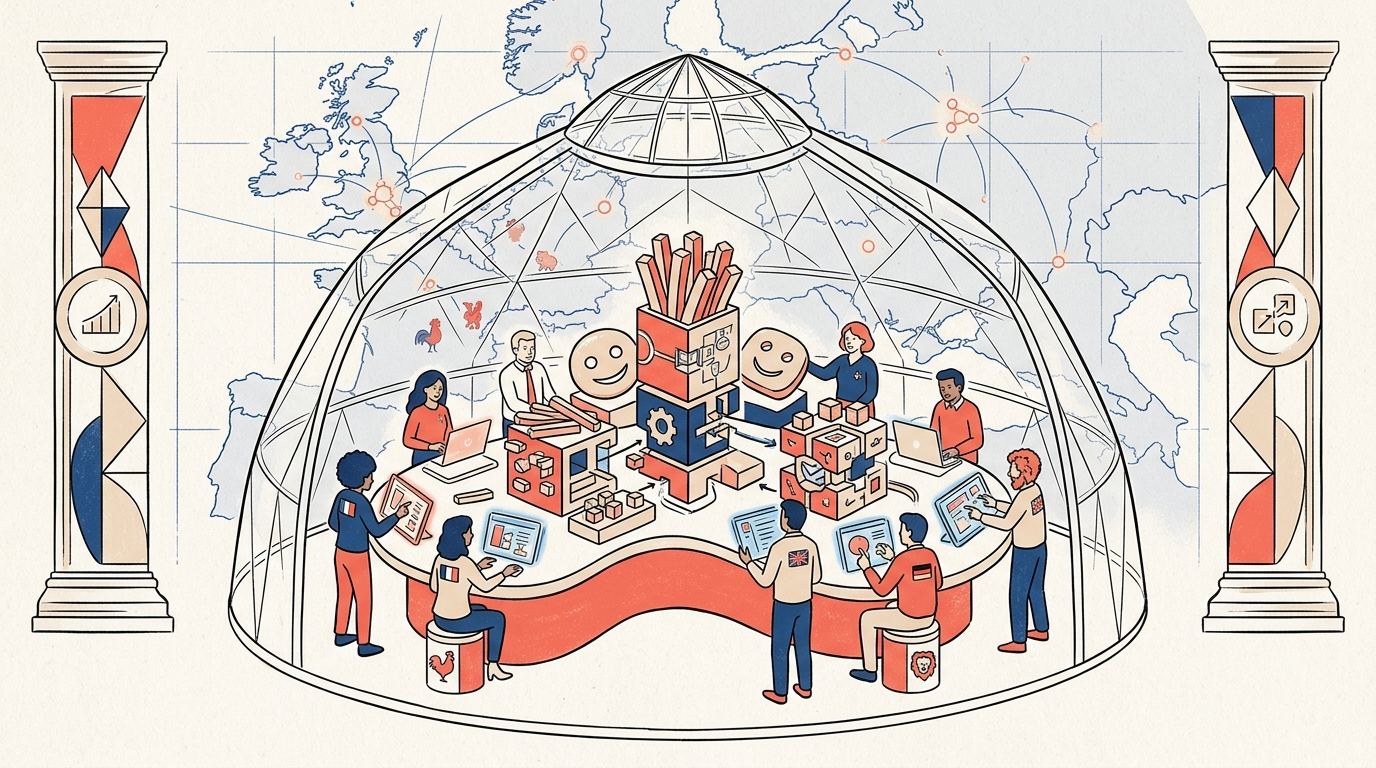
Two characteristics structure this kind of engagement. First, in foodservice the customer is not a consumer: they are an operator whose daily difficulties are recruitment, consistency, waste and service time. That is why the brief asks for service concepts as much as product concepts. Second, the sprint was distributed across countries and run remotely, which makes the collaboration journey a deliverable in its own right. The pillars retained, the concepts and the client's proprietary data are not disclosed.
A leading industrial player: McCain Foods is the world's largest producer of frozen potato specialities. The group employs around 18,000 people and operates some 50 production facilities across six continents. In Europe it operates notably in France, the Netherlands, Belgium and Poland, with sourcing organised as close as possible to its plants.
Foodservice constitutes a channel of its own, with its own expectations, its own routes to market and its own decision cycles.
A customer who is not a consumer: The buyer here is an operator: an independent restaurateur, a chain, a canteen, contract catering, a hotel. They do not choose a product because they like it, but because it allows them to get through service.
Documented daily difficulties: The sector's structural constraints are well known: difficulty recruiting and retaining staff, high turnover, service time at peak, waste, and consistency of the result whoever is in the kitchen. Those constraints drive purchase decisions more than sensory characteristics do.
A Europe that is not homogeneous: Chips do not hold the same status in Belgium, France, the Netherlands, Poland or the United Kingdom: not the same accompaniment, not the same cooking, not the same place in the meal. A European innovation pillar has to hold despite those differences.
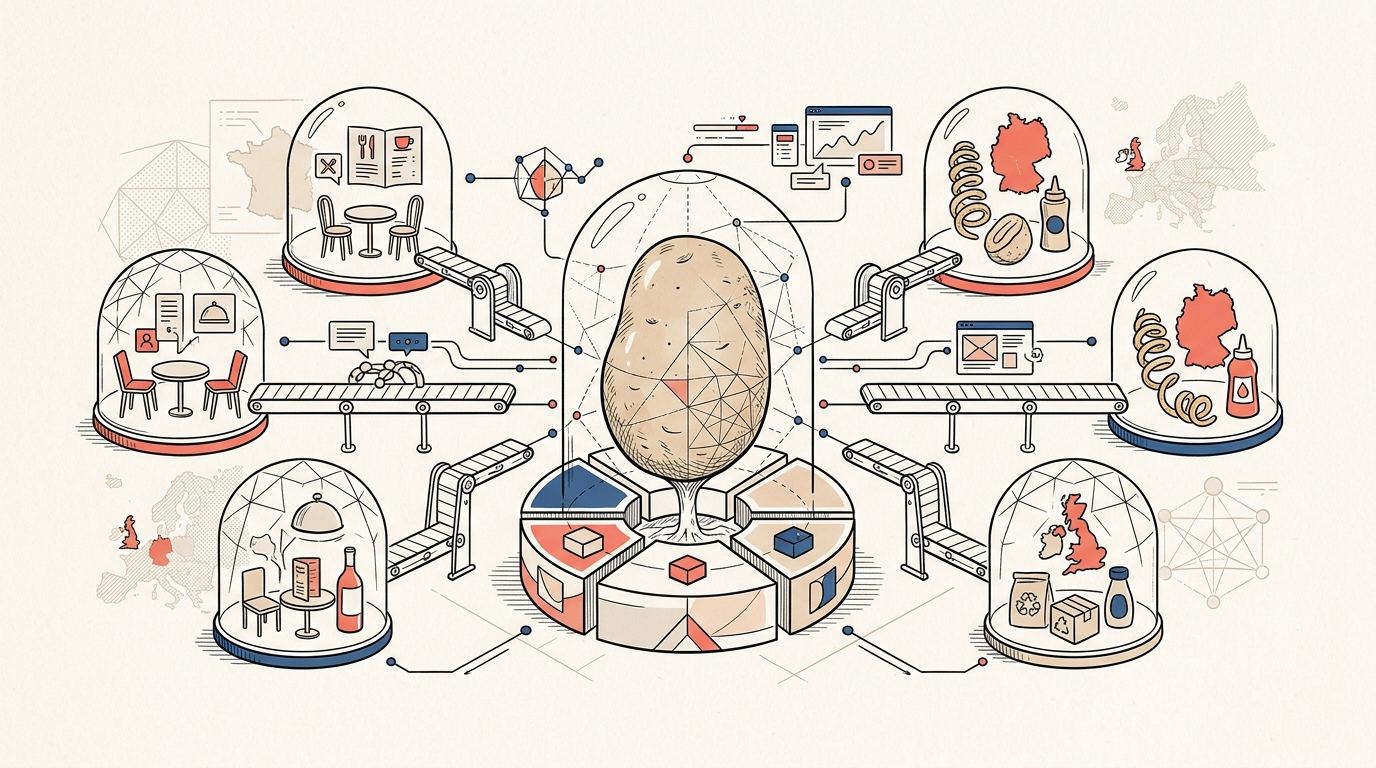
Innovating on service as much as on product: The likely challenge was to open the innovation field beyond recipe and format. If the customer's difficulties are recruitment, consistency and service time, part of the answer lies in packaging, preparation, training, equipment or support — that is, in service.
Converging without standardising: The country marketing teams know markets that do not resemble one another. A European pillar has to be stated at a level where it remains true everywhere, without becoming so general that it directs nothing.
The collaboration journey as a deliverable: A sprint distributed across countries and run remotely does not unfold like a workshop in a room. Asynchrony, time zones, online meeting fatigue and unequal airtime are design parameters, not incidents.
Separating category growth from brand extension: The brief pairs the two. Growing a category's usage among operators and taking a brand onto new service ground commit neither the same means nor the same risks.
Non-negotiable kitchen constraints: Space, equipment, cold chain, cooking time, available skill: a concept requiring a change in kitchen organisation will be set aside whatever its quality.
A long decision cycle: In B2B food, listing runs through trials, distributors and sometimes tenders. Concepts have to be assessable within that calendar.
The sprint was framed around questions of this kind:
A restaurant operator does not buy a taste. They buy time, consistency and margin — taste is a condition, not an argument.
Strategic challenge
The questions that structured the work
Our approach
From analysis to usable decisions
Start from the operator's day
Describe how a service actually unfolds, with its staffing, time and equipment constraints. The product is only one element of that organisation.
Record the workarounds
Document what kitchens improvise to cope. Those makeshift solutions identify uncovered needs better than any declarative survey.
Open the service field explicitly
State from the framing that the answer may be a packaging, a preparation, a training or a support offer, and not only a recipe.
Set the level of the pillars
State each pillar at the level where it remains true in every country without becoming too general. That setting is tested by confronting the countries with one another.
Design the collaboration journey
Treat asynchrony, time zones and airtime as design parameters. Remotely, the format produces the result as much as the content does.
Research and work conducted
What the engagement covered
- The workaround question is the most productive. What an operator improvises to get through service identifies precisely the needs the current offer does not cover.
- The approach applied rests on one principle: in B2B, you start from the operating problem, not from the product.
- A buyer who is not the eater: The operator decides, the end customer consumes. One's criteria are not the other's, and both have to be satisfied.
- Divergent national habits: The product's status, its cooking and its accompaniment vary sharply between European countries.
- The physical constraints of a kitchen: Space, equipment, cold chain and available skill rule out otherwise relevant concepts.
- The distributed, remote format: Time zones, asynchrony, unequal airtime: without explicit design, the same countries speak and the others listen.
- The product reflex: In an industrial company, service ideas need explicit framing to emerge on equal terms with recipe ideas.
- A long listing cycle: Trials, distributors, tenders: the B2B calendar requires concepts to be ranked by assessment lead time.
Business value
A reading that makes trade-offs easier
A wider innovation field
Opening up service doubles the number of possible answers to the same operating problem, often at lower industrial cost.
A customer relationship harder to replace
A service embedded in a kitchen's organisation creates an operational dependency that a product alone does not.
European convergence without standardisation
Pillars set at the right level allow each country to adapt without starting over.
A distributed sprint that actually produces
Designing the collaboration journey prevents a remote workshop from becoming a series of meetings with no output.
Deliverables
Objects teams can use beyond the engagement
- A description of the operator's real day and its pressure points.
- A record of the workarounds observed in kitchens.
- Innovation pillars stated at European level and tested country by country.
- A digital collaboration journey designed for a distributed sprint.
- Product concepts and service concepts treated on equal terms.
- An explicit separation between category growth and brand extension.
- A qualification of concepts against kitchen constraints and the listing cycle.
Key learnings
What this case makes clear
- In foodservice, the customer buys time, consistency and margin: taste is a condition, not an argument.
- When the customer's problem is organisational, part of the answer lies in service rather than product.
- What a kitchen improvises to cope identifies uncovered needs better than a declarative survey.
- A European pillar is set at the level where it stays true everywhere without ceasing to direct.
- Remotely, the collaboration journey is a deliverable, not an organisational detail.
- A concept requiring a kitchen to reorganise will be set aside whatever its quality.
FAQ
Frequently asked questions
How do you run a remote innovation sprint?
By treating the collaboration journey as a deliverable rather than an organisational detail. A sprint distributed across several countries does not unfold like a workshop in a room: asynchrony, time zones, online meeting fatigue and unequal airtime are design parameters. Without an explicit format, the same teams speak and the others listen, and the workshop becomes a series of meetings with no output.
Why innovate on service and not only on product?
Because in B2B the customer's difficulties are often organisational. A foodservice operator faces recruitment, staff turnover, service time at peak, waste and inconsistency of the result depending on who is in the kitchen. Part of the answer then lies in packaging, preparation, training or support. Opening that field explicitly doubles the number of possible answers, often at lower industrial cost.
How do you align marketing teams across countries?
By setting the level at which innovation pillars are stated. A pillar has to be worded at the level where it remains true in each market without becoming so general that it directs nothing. That setting is not a compromise but precise work, tested by confronting the countries with one another: if a pillar speaks to nobody in particular it is pitched too high; if it speaks only to one country it is pitched too low.
What are a restaurant operator's real problems?
Rarely taste, which is an entry condition rather than an argument. The sector's structural constraints are difficulty recruiting and retaining staff, turnover, service time at peak, waste and consistency of the result whoever is in the kitchen. Those constraints drive purchase decisions more than a product's sensory characteristics do.
How do you innovate in B2B food?
By starting from the customer's real day and from what they improvise to cope. The makeshift solutions observed in kitchens — a repurposed utensil, an added step, a buffer stock — identify uncovered needs better than a declarative survey. Each concept then has to be qualified against the physical constraints of the kitchen, and against the listing cycle, which runs through trials and sometimes tenders.