
Reference / Case study 10 / Dairy
Lactalis International: growing butter in China, from Shanghai and from Paris
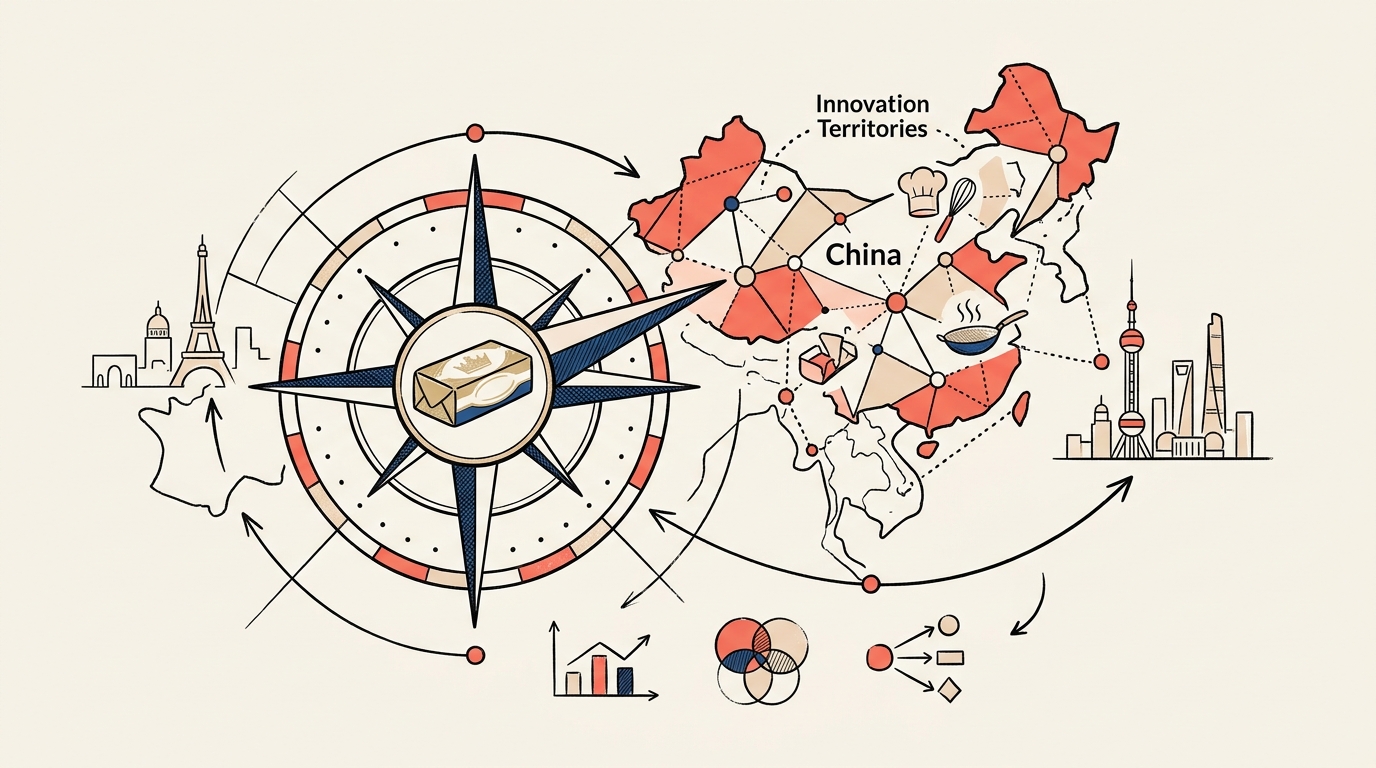
A two-city workshop design for a category with no domestic tradition of use: Paris brought technical category knowledge; Shanghai brought the reality of Chinese demand, channels and occasions.
- Client
- Lactalis International
- Industry group
- Food & Beverage
- Specific industry
- Dairy
- Expertise
- Innovation strategy and workshop facilitation
- Markets
- China, France
- Engagement
- Butter category-growth territories
- Locations
- Shanghai and Paris
- LED AT
- Brainvalue, June Marketing
Context
Lactalis International: growing butter in China, from Shanghai and from Paris
The work designed and facilitated workshops in Shanghai and Paris to identify growth opportunities and innovation territories for butter in China. The two locations were a methodological choice, not a logistical compromise.
Paris held the craft of the category: material, texture, technical applications and pastry knowledge. Shanghai held the market reality: who buys butter in China, through which channels and for which uses. Neither city could supply the whole answer alone.
In a category with no tradition of use, growth comes from a movement already under way, not from a product idea.

Strategic challenge
The questions that structured the work
Our approach
From analysis to usable decisions
Identify movements before ideas
Start with bakery, café, foodservice, premiumisation and changing urban consumption rather than with a European product concept.
Separate the two value chains
Treat professional ingredient and consumer product as distinct propositions with different technical, commercial and distribution criteria.
Let each city contribute what it knows
Use Paris for technical possibilities and Shanghai for live market constraints and meanings, rather than asking either team to guess the other half.
Turn the gap into evidence
Compare the two readings deliberately. Their divergences reveal where technical possibility and cultural accessibility do not yet meet.
Rank routes by behavioural distance
Separate opportunities that accompany an existing movement from those that would first need to create one.
Research and work conducted
What the engagement covered
- Reading the category's growth dynamics in China and separating existing movements from bets that would have to be created.
- Separating professional and consumer opportunities, with their distinct purchase criteria.
- Mapping innovation territories credible for the brand.
- Ranking routes by distance from current behaviour rather than appeal alone.
- Using the gap between Paris and Shanghai readings as a result, not a disagreement.
- Designing two workshop sequences that could work separately while producing comparable material.
Business value
A reading that makes trade-offs easier
Investment where demand is forming
Separating existing movements from created bets changes where a business allocates resources in an emerging category.
Fewer costly projections
Identifying a non-transferable European use early avoids a launch whose failure would be mistaken for execution.
Stronger international alignment
A process that involves headquarters and the market produces more durable agreement than a top-down recommendation.
Two propositions from one craft
Clarifying professional and consumer logic lets teams build coherent routes from the same material expertise.
Deliverables
Objects teams can use beyond the engagement
- A reading of the forces carrying the butter category in China.
- A distinct view of professional and consumer opportunities.
- A map of innovation territories credible for the brand.
- A ranking of routes by distance from current behaviour and investment horizon.
- A structured comparison of the Paris and Shanghai readings.
- Two workshop designs and a presentation for international and local trade-offs.
Key learnings
What this case makes clear
- Growing a category with no tradition of use is different from taking share in an established category.
- In China, butter enters primarily through professional craft before household consumption.
- A single-site workshop often reproduces the habits of the city where it is held.
- A growth opportunity and an innovation territory overlap only partially.
- An import-dependent category must stay viable within price constraints the business does not fully control.
FAQ
Frequently asked questions
Why run innovation workshops in Shanghai and Paris?
Shanghai reveals how the market buys and uses butter; Paris brings the category's technical and craft possibilities. Crossing the two avoids both cultural projection and technical blind spots.
Why separate professional and consumer opportunities?
Professionals assess melting point, fat content, lamination and cost per kilo. Households assess convenience, format, shelf life, origin and price per pack. One route rarely answers both.
What is an innovation territory?
It is a coherent direction for development that a brand can credibly pursue. It is not simply a list of product ideas.
Why rank routes by behavioural distance?
A route that accompanies an existing movement has a different time horizon, risk and investment profile from one that must create a new habit.
What is the risk of home-market projection?
Expertise from a mature market can lead teams to assume a familiar use will transfer. It may be technically sound while having no cultural relevance in the target market.