
Reference / Case study 25 / Food & plant-based
Ecotone: three workshops, three units of analysis — an occasion, a category, a brand
The project covered the design and facilitation of multiple European innovation workshops for Ecotone, spanning breakfast, plant-based alternatives to dairy, and category expansion opportunities for the Bonneterre brand, with the objective of identifying growth territories and future innovation opportunities.
- Client
- Ecotone
- Industry
- Food & beverage · Plant-based food
- Expertise
- Growth strategy · Innovation strategy · Category strategy
- Scope
- Breakfast · Plant-based alternatives to dairy · Bonneterre category expansion
- Geography
- Europe
- Engagement type
- Design and facilitation of multiple European innovation workshops and identification of growth territories
- Consultant
- Aurélie Plessier
- Case No.
- 25
- LED AT
- June Marketing
Context
Ecotone: three workshops, three units of analysis — an occasion, a category, a brand
These three workstreams share a characteristic that often goes unnoticed and that determines everything else: they do not concern the same type of object. Breakfast is a consumption occasion. Plant-based is a product category. Bonneterre is a brand. Three different units of analysis, which do not reveal the same things and do not compare with each other.
Most innovation programmes never make that distinction explicit, and that is precisely why their outputs turn out impossible to rank together. This case describes how you design three different formats for three different questions, while keeping the ability to arbitrate them at the same moment. The territories identified, the conclusions and proprietary client data are not disclosed.
A European group built around a mission: Ecotone was born in 2020 from the renaming of Wessanen, with an explicit mission: to nourish biodiversity. Its public portfolio brings together a dozen national and European brands — Allos, Alter Eco, Bjorg, Bonneterre, Clipper, Danival, Destination, El Granero, Isola Bio, Kallø, Whole Earth and Zonnatura — across seven European countries, with headquarters near Lyon.
The group reported revenue of around €645 million in 2020, of which close to €400 million in France. Bjorg holds leading positions in organic grocery retail: around 61.7% market share in organic plant-based drinks, 50.4% in organic biscuits and 47.1% in organic cereals.
A commitment verified rather than declared: In 2019 Ecotone became the first European food company certified B Corp. On re-certification in 2025 it scored 123.7 points, the highest among large certified French companies across all sectors, and the highest among large certified food companies globally. The group has also been deploying the Planet-score on its products since 2023.
That point has a direct consequence for innovation. In a company whose mission is audited, an attractive route that is weak environmentally is not merely debatable: it is incompatible. The constraint enters the workshop instead of arriving at the end.
Three questions that do not resemble each other: The likely challenge was to run three distinct explorations without treating them identically, while producing results comparable at the point of arbitration.
Breakfast is an occasion. You reason in moments, gestures, time constraints and table compositions. The question posed is: what actually happens in the morning, and what is not served there?
Plant-based is a category. You reason in substitution, product performance, culinary uses and reference points against the original product. The question posed is: what does this product do that its dairy equivalent does not, or does less well?
A brand's category expansion is something else again. You reason in perceived legitimacy. The question posed is: how far can this brand go before the proposition feels forced?
The trap of the single workshop: The economical temptation is to handle all three subjects in one format. It systematically produces the same result: ideas formulated at different levels, impossible to compare, and a final arbitration made on enthusiasm for want of a common criterion.
The European constraint: The group operates in seven countries with largely national brands. An opportunity identified in one market can be structurally inoperative in another — breakfast habits, in particular, are among the most culturally rooted in food.
The workshops were framed around questions of this kind:
When a commitment is verified by a third party rather than declared, it stops being a communication argument and becomes a product development constraint.
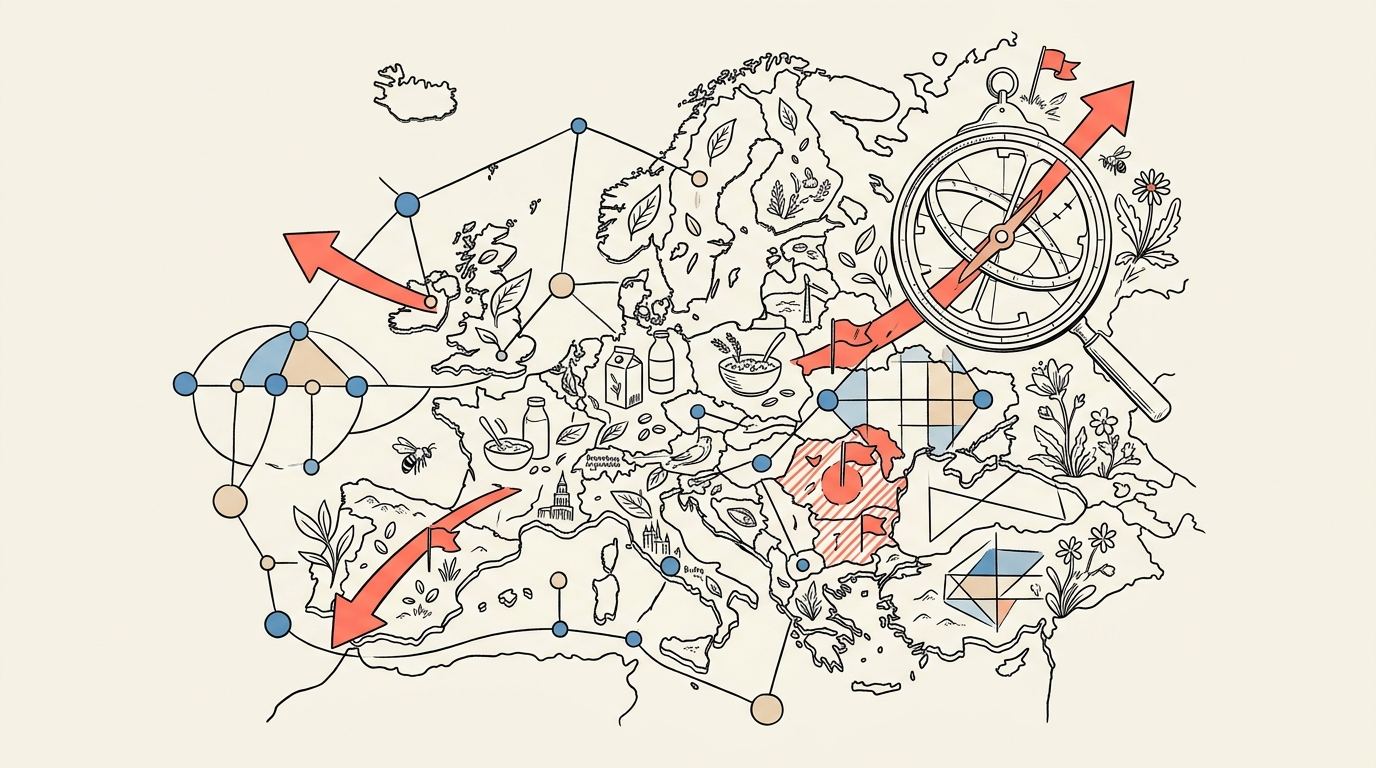
Strategic challenge
The questions that structured the work
Our approach
From analysis to usable decisions
Name the unit of analysis
State explicitly whether you are working on an occasion, a category or a brand. That decision determines participants, stimuli, exercises and output format. It is rarely taken consciously.
Design one format per unit
An occasion workshop rests on observation of lived moments. A category workshop rests on product performance and comparison. An extension workshop rests on perceived legitimacy. Three different designs, not three variants.
Set a shared arbitration criterion upstream
Define, before the sessions, the grid that will allow routes of different natures to be compared: size of prize, feasibility, compatibility with the mission, European transposability.
Bring the environmental constraint into the room
Treat the environmental requirement as a design parameter rather than a filter applied afterwards. In a mission-audited company an incompatible route is not debatable, and knowing that early saves time.
Separate European from national before ranking
Qualify each route by its transposability across the group's markets. A strong but strictly national opportunity does not compare with a moderate but European one.
Research and work conducted
What the engagement covered
- The last question has to be handled upstream. Without a common criterion defined before the workshops, the three outputs will remain incomparable, whatever their individual quality.
- The approach rests on one principle: you choose the unit of analysis before designing the workshop, and you say so.
- Incomparable outputs: Ideas drawn from an occasion, a category and a brand are not formulated at the same level. Without a common grid defined upstream, final arbitration happens on the enthusiasm of whoever presents.
- The cultural rootedness of breakfast: Morning habits are among the most stable and most national in food. An innovation that is obvious in one country can be beside the point in another, without that reflecting any market lag.
- Substitution as the plant-based trap: Reasoning in alternatives locks the category into a comparison it does not always win. Stepping outside substitution logic to identify what the product does better is difficult and necessary.
- Legitimacy as the limit of extension: A brand established on a precise territory holds credibility that does not automatically travel. The constraint is not industrial but perceptual, and it is discovered rather than decreed.
- The environmental requirement as a filter: In a mission-audited company, an attractive but environmentally weak route cannot be improved at the end of the process. It has to be discarded early, which requires the constraint to be present from ideation.
- Multi-country coordination: Making teams from several markets work together requires designs that produce comparable material despite different contexts. This is not one workshop repeated.
Business value
A reading that makes trade-offs easier
Arbitration that becomes genuinely possible
A common grid defined upstream allows routes from three different explorations to be compared. Without it, the three workstreams produce results that coexist without ever being ranked.
Fewer developments stopped late
Bringing the environmental constraint into ideation avoids committing work to routes that will be discarded later for reasons known from the outset.
Better European allocation
Separating transposable opportunities from national ones avoids industrialising for seven countries an answer relevant in one.
A capability that stays
Documented, transferred designs allow teams to relaunch an exploration without external input, on other brands and other subjects.
Deliverables
Objects teams can use beyond the engagement
- Three distinct workshop designs, built around the unit of analysis specific to each subject.
- A map of breakfast moments and unserved occasions.
- A reading of the plant-based category beyond substitution logic.
- A qualification of the boundaries of legitimacy for the Bonneterre brand.
- Growth territories formulated for each workstream.
- A shared arbitration grid allowing routes of different natures to be compared.
- A distinction between European opportunities and strictly national ones.
- Documented workshop formats, handed over to the teams for reuse.
Key learnings
What this case makes clear
- The unit of analysis — occasion, category or brand — is the most structuring decision in an innovation programme, and the least often made explicit.
- An occasion reveals unserved moments, a category missing performance, a brand boundaries of legitimacy. The three do not compare spontaneously.
- Without an arbitration grid defined before the workshops, final selection happens on enthusiasm.
- In plant-based, reasoning in substitution locks the category into a comparison it does not always win.
- Breakfast is among the most culturally rooted occasions: a national obvious is rarely a European obvious.
- In a mission-audited company, the environmental constraint is a design parameter, not an end-of-process filter.
FAQ
Frequently asked questions
How do you choose the unit of analysis for an innovation workshop?
By naming it explicitly before designing the format. Three main units exist. The occasion starts from lived moments and reveals what is not served. The category starts from product performance and reveals what is missing in use. The brand starts from perceived legitimacy and reveals how far you can go. Each calls for different participants, stimuli, exercises and output formats. This is the most structuring decision in an innovation programme, and also the one most often taken without noticing.
What is the difference between an occasion, a category and a brand as a starting point?
They reveal different things. Working on an occasion such as breakfast surfaces unserved moments, time constraints and gestures. Working on a category such as plant-based surfaces performance gaps and barriers to use. Working on a brand surfaces boundaries of perceived legitimacy. All three produce ideas formulated at different levels, which do not compare spontaneously — hence the need for an arbitration grid defined before the sessions.
How do you identify growth territories?
By crossing what is possible with what is legitimate. A growth territory is neither a product idea nor a market segment: it is a space where identifiable demand meets absent or insufficient supply, and which the brand can credibly occupy. Validation requires three successive checks: the reality of the need, the brand's credibility on that ground, and industrial and regulatory feasibility. An empty space the brand cannot occupy is not a territory for it.
How do you innovate on breakfast?
By starting from observation rather than from products. Breakfast is among the most culturally rooted occasions in food: compositions, timings, gestures and degree of preparation vary sharply between countries and generations. An innovation that seems obvious in one market can be structurally beside the point in another, without that reflecting any lag. The method is to map the real moments of the morning, then identify those no offer serves.
How do you extend a brand into new categories?
By testing perceived legitimacy before industrial feasibility. The limit of an extension is almost never technical: it is what audiences accept seeing the brand do. A brand established on a precise territory holds credibility that does not automatically travel. The practical test is to say the extension out loud and observe whether it spontaneously calls for justification. If it does, the space may exist, but it probably belongs to a different brand.