
Reference / Case study 43 / Food & confectionery
Carambar & Co / Lutti: in confectionery, a range role that is not visible on the pack does not exist
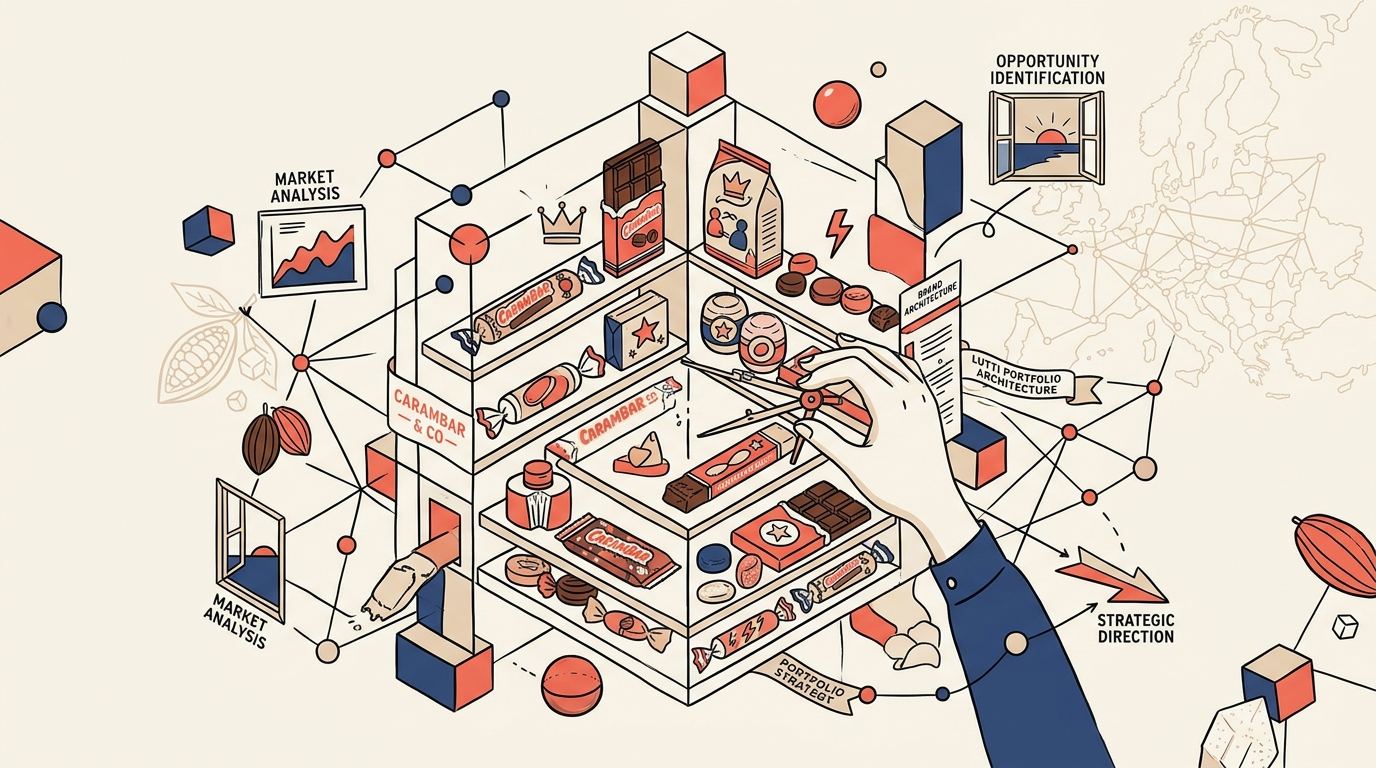
The project focused on clarifying the Lutti portfolio architecture: defining the strategic role of each range, then translating that role into coherent packaging cues across the portfolio.
- Client
- Carambar & Co (Lutti portfolio)
- Industry
- Food & confectionery
- Expertise
- Brand architecture · Portfolio strategy
- Category
- Sugar confectionery
- Geography
- Europe
- Nature of the engagement
- Clarifying the strategic role of each range and translating it into packaging cues
- Consultant
- Aurélie Plessier
- Case no.
- 43
- LED AT
- June Marketing
Context
Carambar & Co / Lutti: in confectionery, a range role that is not visible on the pack does not exist
The context is documented. Lutti, France's third-largest confectionery player and a leading Belgian brand in bagged sugar confectionery, joined the group built around Carambar in 2018 following a transaction cleared by the French competition authority. The group has since brought together brands of very different origins — Carambar, Krema, La Pie Qui Chante, Poulain, Malabar, Vichy, Terry's — and was sold by Eurazeo to Ferrero in October 2025. These facts are given as context only; no causal relationship with the project is suggested.
The difficulty specific to this category lies in where the decision is taken. Sweets are bought in a few seconds, in front of a wall of colour, often with no prior intention. An architecture that exists in a meeting but not on the pack therefore changes nothing. That is why the brief explicitly pairs defining the roles with translating them into visual cues. The conclusions and the client's proprietary data are not disclosed.
A portfolio born of successive successes: Like most confectionery portfolios, Lutti's did not result from an initial plan. It formed through successive additions: a format that worked, a recipe taken up again, a range extension, an acquisition. Each element has a historical reason for existing; the whole has no explicit logic.
The combination with Carambar, completed in 2018 after clearance by the French competition authority, placed this range inside a wider group bringing together brands of very different origins and statuses.
A decision taken in front of a wall of colour: The confectionery fixture is one of the densest in grocery retail. Bags of similar size, saturated colour palettes, close sensory promises: visual differentiation is weak and decision time very short.
A category with no functional benefit: Sweets differentiate through neither measurable performance nor a health benefit. What remains for organising a portfolio is the moment, the gesture, the format, the texture and the recipient.
A buyer who is not always the consumer: The child chooses, the parent pays; the adult sometimes buys for themselves without admitting it; a sharing bag does not hold the same status as an individual format. These configurations are not population segments but purchase situations.
Recovering a logic that was never designed: The likely challenge was to give an explicit logic to a set that formed without a plan. The exercise is not to draw an ideal architecture but to recognise the one that already exists in usage, then clarify it.
Defining a role means defining an exclusion: Assigning a role to a range means saying what it does not do. That is the hard part: in a portfolio made of successes, every range has arguments for doing everything, and teams have good reasons to want to extend each of them.
Visual translation as the condition of existence: The second half of the brief is in fact the condition of the first. In a fast-purchase category, an architecture not translated into visible cues produces no effect: not for the consumer, not for the retailer, not for the teams who have to apply it.
A three-level hierarchy: The cue system has to say three things in one second: which brand, which range, which product. Too many range-specific cues dissolve the brand; too few make the ranges indistinguishable.
An industrial and commercial constraint: Redesigning packaging cues commits tooling costs, production lead times, stock run-off and negotiation with retailers. An architecture not costed in those terms cannot be applied.
The work was framed around questions of this kind:
In confectionery, the pack is not one communication channel among others. It is the only one. A range role that is not visible there stays a slide.

Strategic challenge
The questions that structured the work
Our approach
From analysis to usable decisions
Start from usage, not the catalogue
Describe what each range already serves — moment, gesture, format, recipient — rather than what it claims. The real role precedes the desired one.
Make overlaps visible
Identify the ranges serving the same situation. In a portfolio built by addition, those overlaps are frequent and rarely measured.
Write the exclusion
State for each range what it must stop doing. Without that sentence, architecture remains description.
Translate into three levels of cue
Separate what belongs to the brand, what identifies the range and what signals the product. Visual hierarchy is the concrete form of architecture.
Cost the transition
Establish the cost, timeline and order of pack redesign, accounting for stock and commercial negotiation.
Research and work conducted
What the engagement covered
- The exclusion question — what each range must stop doing — is what gives the exercise its value. An architecture that excludes nothing structures nothing.
- The approach applied rests on one principle: in confectionery, architecture is designed at shelf speed.
- A portfolio never designed as one: The ranges exist for legitimate historical reasons that do not add up to an overall logic.
- Resistance to exclusion: Every range has results to defend and therefore arguments for doing everything. Saying what it will stop doing is the main difficulty.
- Weak visual differentiation: The confectionery fixture saturates colour and graphics. The signals available to stand out are few.
- Decision time: The purchase happens in a few seconds, often with no prior intention. Any subtlety disappears.
- The cost of redesign: Changing packaging cues commits tooling, stock and retail negotiation. The transition has to be sequenced.
- The brand-range balance: Too many range-specific cues dissolve the brand; too few make ranges indistinguishable. The setting is narrow.
Business value
A reading that makes trade-offs easier
A more legible fixture
A clear visual hierarchy reduces the time needed to find, which matters more than a product argument in an impulse purchase.
Less internal competition
Making overlaps visible allows them to be arbitrated rather than funding two ranges on the same situation.
An argument for retailers
A clear architecture can be presented in a range review: it justifies a facing and an order on the fixture.
Framed innovation decisions
Knowing what a range must stop doing reduces the number of projects launched then abandoned.
Deliverables
Objects teams can use beyond the engagement
- A description of the role each range actually plays, based on usage.
- An identification of internal overlaps between ranges.
- An explicit statement of what each range must stop doing.
- A three-level cue hierarchy: brand, range, product.
- The translation of architecture into applicable packaging principles.
- A sequenced transition accounting for stock and cost.
Key learnings
What this case makes clear
- In confectionery, the pack is the only communication channel: a role invisible on the pack does not exist.
- A portfolio built by successive addition has an implicit logic that must be recognised before being corrected.
- An architecture that excludes nothing structures nothing.
- Without a functional benefit, portfolio organisation runs through moment, gesture, format and recipient.
- The buyer is not always the consumer: these are purchase situations, not population segments.
- The balance between brand cues and range cues is narrow in both directions.
FAQ
Frequently asked questions
How do you structure a confectionery portfolio?
Through moment, gesture, format and recipient, for want of a differentiating functional benefit. Sweets are distinguished by neither measurable performance nor a health benefit: the only organising variables available are situational. The approach is to describe what each range already serves in usage, identify the ranges serving the same situation, then write for each what it must stop doing.
How do you translate brand architecture into packaging?
Through a three-level cue hierarchy: what belongs to the brand and never varies, what identifies the range, what signals the product. The setting is narrow in both directions — too many range-specific cues dissolve the brand, too few make the ranges indistinguishable. The time constraint is decisive: the pack has to say those three things in one second, on a fixture saturated with colour.
Why must a range role be visible on the pack?
Because in a fast-purchase category, packaging is the only communication channel actually present at the moment of decision. An architecture defined in a meeting but not translated into visible cues produces no effect: not for the consumer, who does not perceive it, not for the retailer, who has no assortment argument, not for the teams, who have nothing to apply. Visual translation is not an implementation step, it is the condition of existence.
How do you organise a range built from successive products?
By recognising the implicit logic before imposing a new one. A portfolio built by addition — a format that worked, a recipe revived, an acquisition — has no initial plan but already possesses a de facto organisation in usage. The exercise is to describe that real organisation, measure the overlaps it contains, then clarify it. Drawing an ideal architecture without that step produces a plan nothing supports.
How do you manage a portfolio in impulse purchase?
By designing at shelf speed. The purchase happens in a few seconds, often with no prior intention, in front of a visually saturated offer: any subtlety disappears. That imposes two disciplines. First, retain only distinctions perceptible without explanation. Second, cost the transition — tooling, stock run-off, assortment negotiation — because an architecture not sequenced in those terms remains inapplicable.