Reference / Case study 38 / Wine & spirits
Captain Morgan: launching a brand where you are not allowed to advertise
The project focused on the launch of an international rum brand in the Indian market.
- Client
- Captain Morgan
- Industry
- Wine & spirits
- Expertise
- Launch strategy · Positioning · International strategy
- Category
- Rum
- Geography
- India
- Nature of the engagement
- Launch work for an international rum brand in the Indian market
- Consultant
- Aurélie Plessier
- Case no.
- 38
- LED AT
- Grey Mumbai
Context
Captain Morgan: launching a brand where you are not allowed to advertise
Three documented constraints structure this kind of entry. Direct advertising for alcoholic drinks is prohibited in India on television and outdoor: brands have only surrogate advertising, event sponsorship and social channels, within a frame whose interpretation evolves. Excise, distribution and labelling are regulated at state level, producing a mosaic of rules, prices and routes to market. And rum is not a vacant category: Old Monk has held a position there for decades that is better described as affective than competitive.
The likely strategic challenge was therefore to build a presence without the usual tools of brand building, in a market that is not one market but many, against a competitor whose advantage does not rest on the product. The conclusions, recommendations and the client's proprietary data are not disclosed.
A market without direct advertising: In India, advertising for alcoholic drinks is prohibited on television and outdoor media. Brands rely on surrogate advertising — communication for a non-alcoholic product carrying the same name, such as bottled water, music or glassware — on event sponsorship and on social channels, within a frame whose interpretation evolves.
That constraint changes the nature of brand work. What advertising does elsewhere — establish awareness, explain a proposition, create preference ahead of purchase — has to be obtained here through the point of sale, the bar, recommendation and use.
A market that is not one market: Excise, distribution, licensing, labelling and trading hours are set by the states. Some practise prohibition, some operate a public distribution monopoly, others a private licensing regime. Price, availability and routes to market therefore vary sharply from one state to the next.
A competitor that is not only a competitor: Indian rum has long been associated with Old Monk, a brand established for decades and carrying a strong affective charge. That attachment does not rest on product performance and does not move through a comparison of quality.
Building awareness without paid media: The likely strategic challenge was to establish a brand without access to the tool ordinarily used to do so. That shifts investment towards what remains available: bar presence, sales-team training, service, recommendation, the experience of the first drink.
Sequencing by state rather than by country: A uniform national plan makes no sense when rules, prices and routes differ between states. The question becomes one of sequence: where to start, through which channel, and on what criterion to move to the next state.
Not attacking the incumbent head-on: A competitor whose advantage is affective cannot be contested on taste or quality. An entrant has more to gain by occupying a different occasion — another moment, another serve, another company — than by claiming superiority.
Finding what can be said: Under an advertising ban, every brand territory has to be expressible through permitted means. A platform that assumes a media campaign is unusable, however accurate it may be.
Working within the cost of entry: Excise duties, state licences and import structures weigh on the final price and therefore on the segment that can be reached. Positioning cannot be decided independently of that constraint.
The work was framed around questions of this kind:
India is not a spirits market: it is a series of markets sharing a commercial language but not a regulatory frame.
Strategic challenge
The questions that structured the work
Our approach
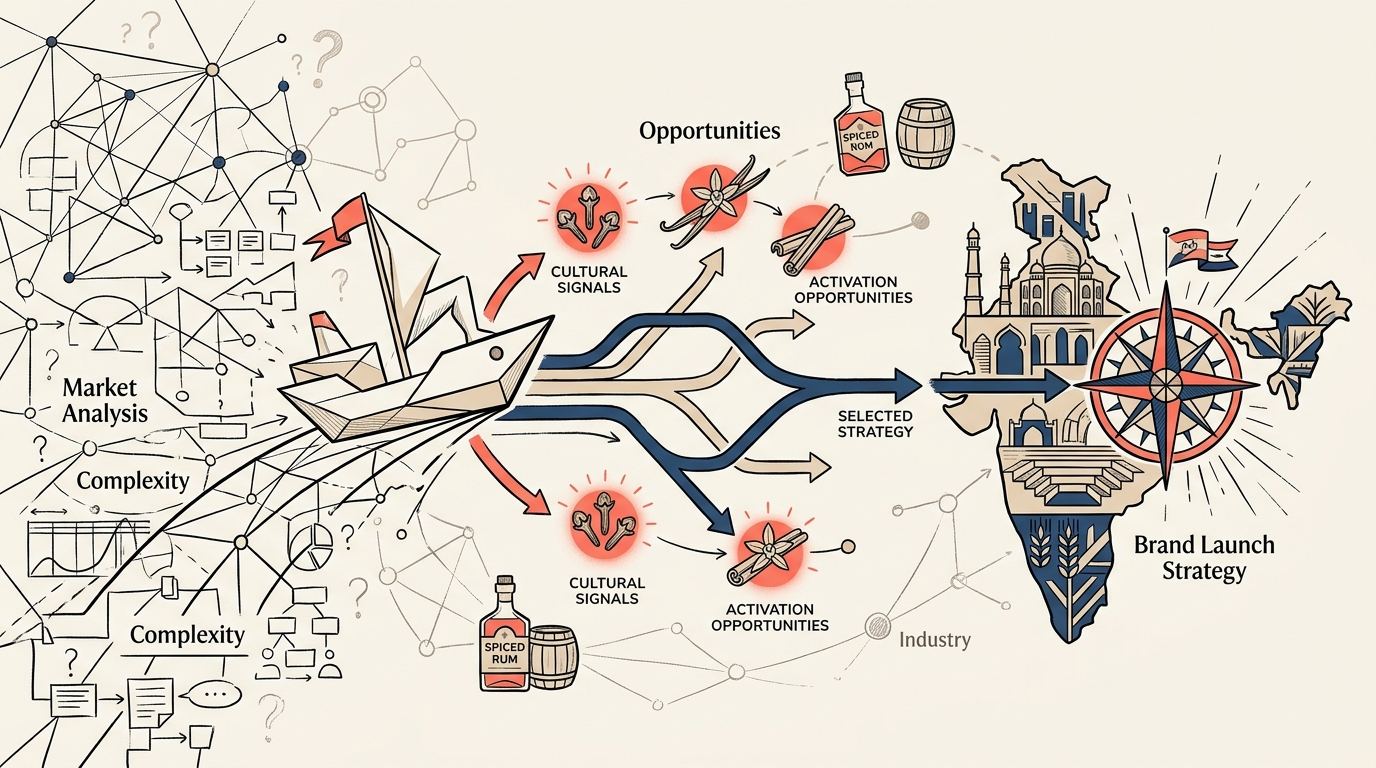
From analysis to usable decisions
Inventory the means actually available
Establish what is permitted before defining a strategy. Under an advertising ban, the list of means conditions the strategy rather than the reverse.
Understand the nature of the incumbent's advantage
Distinguish a product advantage from a distribution advantage from an attachment. The three are not contested by the same means, and the third is not contested at all.
Look for uncovered occasions
Identify the moments the heritage brand does not occupy. An entrant gains more by settling in vacant space than by contesting loaded space.
Treat the market as a sequence of states
Choose an entry point, a channel and a criterion for moving to the next state. A uniform national plan ignores regulatory reality.
Let the place carry the brand
Transfer awareness building to the bar, the point of sale, service and recommendation, the only fully available channels.
Research and work conducted
What the engagement covered
- The attachment question is the most structuring. Understanding what an affective preference rests on also reveals what it does not cover, and that is the space where an entrant can position itself.
- The approach applied rests on one principle: when you cannot speak, you enter through the place and the moment.
- The ban on direct advertising: The usual awareness-building tool is unavailable, and the alternatives are regulated and subject to shifting interpretation.
- State-level fragmentation: Excise, licences, distribution, labelling and hours vary by state. Each entry is a distinct regulatory project.
- An attachment that cannot be contested: The incumbent's position rests on an affective charge that neither quality nor price displaces.
- The cost of entry: Duties, licences and import structures weigh on the final price and restrict the segment that can be reached.
- The social sensitivity of the category: Attitudes to alcohol vary sharply by region and milieu. A territory acceptable in a metropolis may not be acceptable elsewhere.
- Dependence on the channel: Where distribution is a public monopoly, shelf presence depends on administrative decisions that no amount of brand work compensates for.
Business value
A reading that makes trade-offs easier
A genuinely executable strategy
Defining the available means before the strategy avoids producing a platform that assumes an impossible media campaign.
A confrontation avoided
Occupying a vacant occasion rather than contesting an attachment saves an investment whose return would be low.
Better-sequenced deployment
Treating India as a sequence of states makes it possible to learn in one market before committing to the next.
Investment redirected to what works
Under an advertising ban, the bar, the point of sale and team training produce the awareness media would produce elsewhere.
Deliverables
Objects teams can use beyond the engagement
- An inventory of the communication means actually available within the applicable frame.
- An analysis of the nature of the heritage brand's advantage.
- A map of rum consumption occasions, covered and uncovered.
- Brand territories expressible without direct advertising.
- A state-by-state sequencing logic rather than a uniform national plan.
- The implications for the point of sale, the bar and service.
Key learnings
What this case makes clear
- When advertising is prohibited, the list of available means conditions the strategy and not the reverse.
- An advantage founded on attachment cannot be contested by product or by price.
- An entrant gains more by occupying a vacant occasion than by contesting loaded space.
- A market regulated at state level is a sequence of markets, not a single one.
- Without media, brand building moves to the place, the service and recommendation.
- Positioning cannot be decided independently of the regulatory cost of entry.
FAQ
Frequently asked questions
How do you launch an alcohol brand in India?
By building the strategy from the permitted means rather than the reverse. Direct advertising for alcoholic drinks is prohibited on television and outdoor: what remains is surrogate advertising, event sponsorship and social channels, within a frame whose interpretation evolves. Awareness is therefore built through the bar, the point of sale, team training and recommendation. The country also has to be treated as a sequence of states, each with its own excise, licences and distribution channel.
Can you advertise alcohol in India?
Not directly. Television and outdoor media are closed to alcoholic drinks. Brands rely on surrogate advertising — communication for a non-alcoholic product carrying the same name, such as bottled water, music or glassware — together with event sponsorship and social channels. This frame is regulated and its interpretation evolves, which makes it necessary to check the expressibility of any brand territory before adopting it.
How do you compete with an emotionally established brand?
Not head-on. An advantage founded on attachment is contested neither by quality nor by price: those arguments address a rational evaluation that is not what produces the preference. The workable route is to understand what the attachment rests on in order to identify what it does not cover — another moment, another serve, another company — then to occupy that vacant space rather than contest the loaded one.
Why is the Indian spirits market fragmented?
Because excise, licensing, distribution, labelling and trading hours are set by each state rather than federally. Some states practise prohibition, some operate a public distribution monopoly, others a private licensing regime. Price, availability and routes to market therefore vary sharply. A uniform national plan makes no sense: each entry is a distinct regulatory project, which makes sequencing the deployment necessary.
How do you build awareness without paid media?
By transferring brand building to the channels that remain fully available: presence and service in bars, the point of sale, sales-team training, the experience of the first drink and recommendation. These levers work more slowly than a campaign but produce a more stable preference, because it rests on a lived experience rather than a received message. They do, however, require a chosen geographic footprint and therefore a sequenced deployment.