Reference / Case study 40 / Wine & spirits
Canard-Duchêne: in champagne, the occasion is decided before the brand
The project focused on designing and facilitating brand platform and activation workshops, intended to help the teams clarify their strategic direction and prepare for future brand development.
- Client
- Canard-Duchêne
- Industry
- Wine & spirits
- Expertise
- Brand platform · Activation strategy · Workshop
- Category
- Champagne
- Geography
- Europe
- Nature of the engagement
- Design and facilitation of brand platform and activation workshops to clarify strategic direction
- Consultant
- Aurélie Plessier
- Case no.
- 40
- LED AT
- June Marketing, Labbrand
Context
Canard-Duchêne: in champagne, the occasion is decided before the brand
The context is documented. Founded in 1868 at Ludes, in the Montagne de Reims, Canard-Duchêne has belonged since 2004 to Alain Thiénot's group. The house has moved from fifteenth to tenth among champagne houses by volume and holds second position in French grocery retail, with around 5.7% volume share behind Nicolas Feuillatte. It launched its first organic cuvée in 2009 and today accounts for a large majority of the organic champagne sold through French grocery retail.
The likely strategic difficulty stems from a characteristic of the category. In champagne, the occasion is decided before the brand: you choose to celebrate, then you choose a bottle. The category already carries the meaning, which leaves each house with a narrow and difficult question — why this one rather than another — to be answered in a few seconds in front of a fixture. The conclusions and the client's proprietary data are not disclosed.
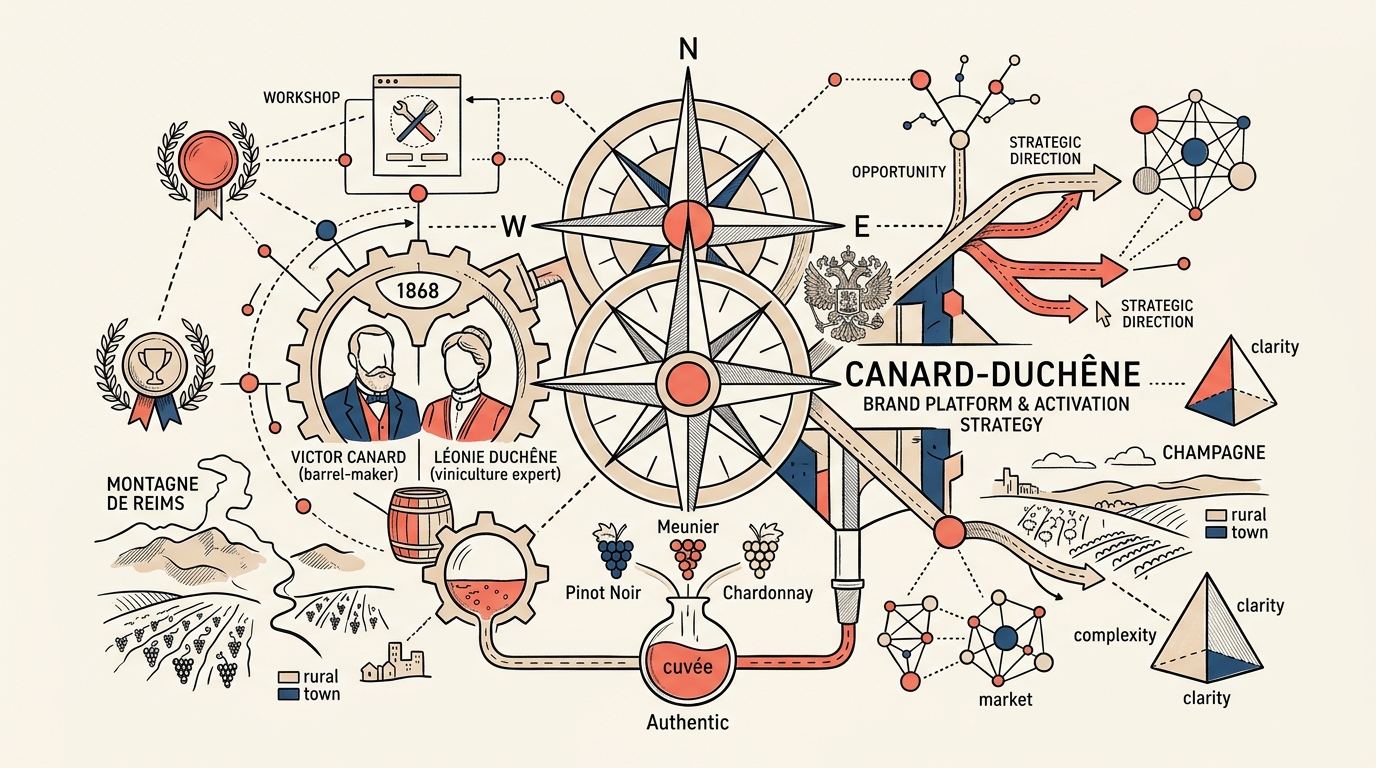
An old house on a recent trajectory: Canard-Duchêne was founded in 1868 by a cooper and a winegrower's daughter, at Ludes on the Montagne de Reims. After a long period inside a luxury group, the house was acquired in 2004 by Alain Thiénot, a Champagne broker who became a house owner, within a family group that today brings together estates in Champagne, Bordeaux and California.
Since then the house has moved from fifteenth to tenth among champagne houses by volume. In French grocery retail it holds second position with around 5.7% volume share, behind Nicolas Feuillatte.
A genuine lead in organic: The house began organic vinification in the mid-2000s and launched its first organic cuvée in 2009. It today accounts for a large majority of the organic champagne sold through French grocery retail.
A category that already carries the meaning: Champagne differs from most categories in that the occasion precedes the choice. The decision to open a bottle is taken before the brand comes into play: it is the celebration, the invitation or the gift that triggers the purchase.
That precedence narrows the brand's space to one precise question — why this one — asked in a context where the buyer has little time and few reference points, particularly in grocery retail.
Answering a narrow question: The likely strategic challenge was to clarify what the house contributes when the category has already said everything. A champagne platform cannot claim celebration, sharing or festivity: those territories belong to the category and are therefore unavailable.
Turning a lead into a position: A lead in organic is a rare asset. But a product attribute, however solid, does not make a platform: what it says about the house, its relationship to the vineyard and its way of working has to be established, failing which it remains an imitable label mention.
Holding up at shelf speed: In grocery retail, champagne is chosen quickly, often in front of a wide and visually undifferentiated offer. Any strategic direction has to translate into signals legible at that speed, or it will produce no commercial effect.
A platform that must be actionable the next morning: The brief pairs platform and activation, and that pairing is decisive. An unactivated platform remains a document; designing both workshops as a single movement was therefore a methodological decision, not an organisational convenience.
Working within a strict regulatory frame: The appellation governs what a house may say, and French regulation on alcoholic drinks limits staging. A brand territory has to be expressible within both frames to have practical value.
The workshops were framed around questions of this kind:
A product lead is not a positioning. Organic says what the house does; it does not yet say what the house is.
Strategic challenge
The questions that structured the work
Our approach
From analysis to usable decisions
Remove what belongs to the category
Set aside from the outset the territories the category already claims — festivity, sharing, celebration. What remains after that subtraction is the space genuinely available.
Move from attribute to posture
Establish what a production practice says about how a house works. An attribute can be imitated; a posture takes hold.
Confront the direction with shelf time
Check that the direction translates into signals perceptible within seconds, in a fast and undifferentiated purchase context.
Write the activation during the workshop
Produce, in the same session, what the teams will actually do with their current means. A platform whose activation is deferred remains a document.
Test the platform on real trade-offs
Submit the wording to concrete pending decisions. If it does not settle them, it is not yet operational.
Research and work conducted
What the engagement covered
- The last question is the most useful at the end of a workshop. A platform is judged by its ability to settle concrete trade-offs, not by the accuracy of its wording.
- The approach applied rests on one principle: a platform and its activation are designed in the same movement.
- Territories confiscated by the category: Festivity, sharing, celebration: the most natural words are also the least available, since they belong to champagne in general.
- A strong but imitable attribute: A lead in organic can be caught up. It becomes a durable position only if it is tied to a way of working.
- The speed of choice on shelf: In grocery retail, a difference that requires explanation does not have time to exist.
- A double regulatory frame: The appellation governs product claims; alcohol regulation governs communication. Both narrow the space for expression.
- The gap between the workshop and the next morning: The recurring difficulty of this format is not producing a direction, it is having it survive the return to routine work.
- Means that have to be calibrated: An activation designed for means the team does not have produces frustration rather than execution.
Business value
A reading that makes trade-offs easier
A direction that survives the workshop
Writing the activation in the same session is what distinguishes an applied platform from an archived one.
A product asset turned into a position
Tying a production practice to a brand posture makes the advantage harder to imitate.
Faster trade-offs
A platform tested on real decisions saves time on every decision that follows.
An autonomous team
A well-run workshop leaves a method behind it, not only a conclusion.
Deliverables
Objects teams can use beyond the engagement
- A map of what the category claims and what remains available.
- A brand platform expressed in terms the teams can use.
- The explicit move from product attribute to house posture.
- A shelf-perceptibility test for each signal retained.
- An activation plan written during the workshop, calibrated to real means.
- A list of concrete trade-offs the platform should be able to settle.
Key learnings
What this case makes clear
- In champagne, the occasion precedes the brand: the house justifies the choice within the occasion, not the occasion itself.
- The territories the category claims are unavailable to any individual house.
- A product attribute, however rare, becomes a position only when tied to a way of working.
- In grocery retail, a difference that requires explanation does not exist.
- A platform whose activation is deferred remains a document.
- A platform is judged by its ability to settle concrete trade-offs.
FAQ
Frequently asked questions
How do you build a brand platform in champagne?
By starting with subtraction. Champagne is a category where the occasion precedes the choice: festivity, sharing and celebration belong to the category and are therefore unavailable to any individual house. What remains after that subtraction is the genuinely usable space — usually the vineyard, the way of working, the posture of the house. The platform then has to translate into signals perceptible within seconds, particularly in grocery retail.
Why must a brand platform be activated immediately?
Because a platform whose activation is deferred remains a document. The difficulty of this kind of engagement is not producing an accurate direction, it is having it survive the return to routine work. Designing the platform and its activation in a single movement — writing during the workshop what the teams will do the next morning, with the means they actually have — is what distinguishes an applied platform from an archived one.
How do you differentiate when the occasion already justifies the purchase?
By giving up on justifying the occasion. In occasion-led categories — champagne, flowers, gifting, patisserie — the decision to buy is taken before the brand comes into play. The brand therefore does not have to explain why to celebrate, but why itself rather than another within that celebration. It is a narrower question, addressed through signals of recognition and trust rather than through a discourse on the meaning of the occasion.
Is organic a positioning or a product attribute?
It is an attribute as long as it is not tied to a way of working. A genuine lead in organic is a rare asset, but an attribute can be imitated: as soon as others carry the same mention, the advantage erodes. It becomes a position when it is connected to what it says about the house — its relationship to the vineyard, its vinification choices, its consistency over time — that is, when it stops being a label mention and becomes a posture.
How do you judge the quality of a brand platform?
By submitting it to real, pending trade-offs. A platform is judged by its ability to settle concrete decisions — whether to launch this cuvée, accept this trade promotion, enter this channel — not by the elegance of its wording. If it excludes nothing, it directs nothing. That is why the most useful closing sequence of a workshop is to list the open decisions and check that the platform separates them.