
Reference / Case study 21 / Beauty & luxury
Burberry Beauty: translating a House into a smell, the hardest constraint in luxury
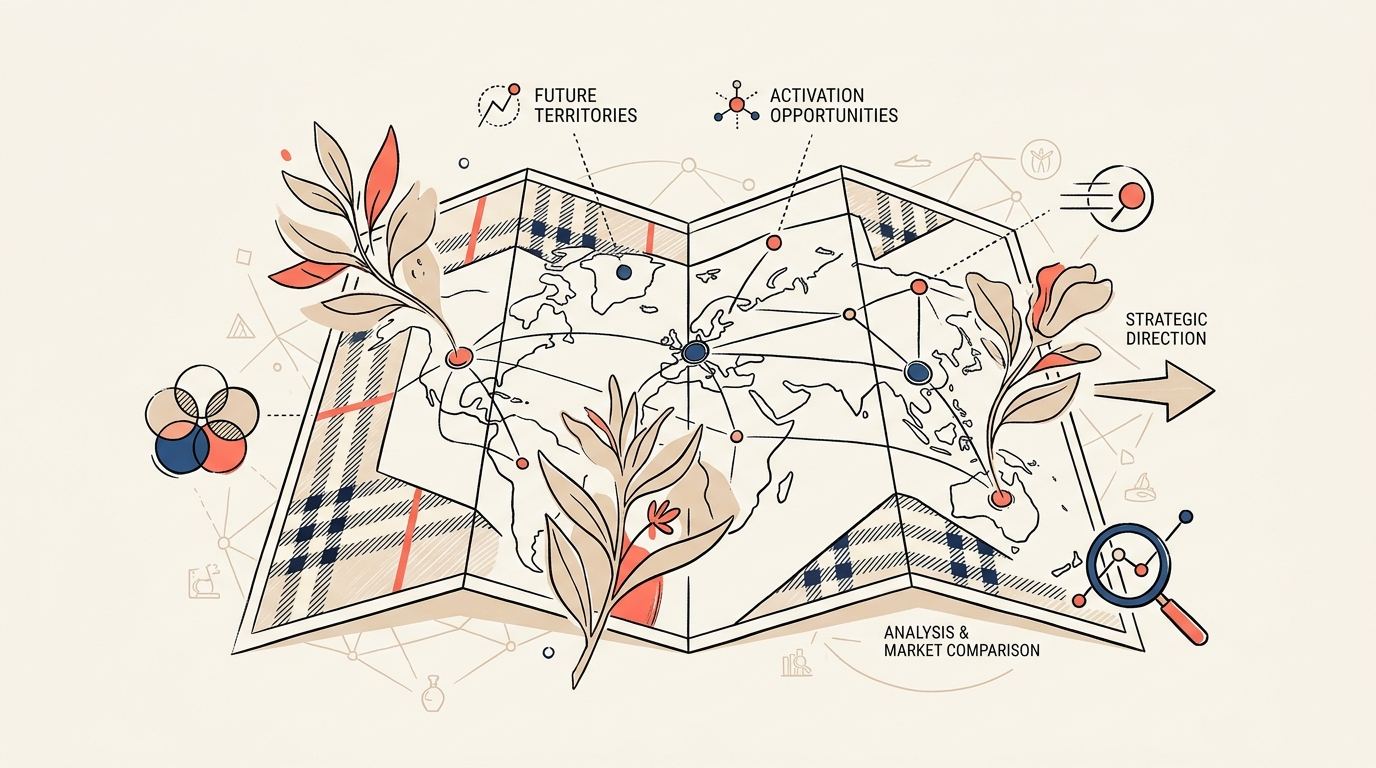
The project covered the design and facilitation of a fragrance innovation workshop for Burberry Beauty, intended to explore future innovation territories and activation opportunities aligned with the brand vision.
- Client
- Burberry Beauty
- Industry
- Beauty & luxury — fragrance
- Expertise
- Innovation strategy · Workshop facilitation · Brand activation
- Object
- Future innovation territories and activation opportunities
- Geography
- Asia · Europe · Americas
- Engagement type
- Design and facilitation of a fragrance innovation workshop aligned with the brand vision
- Consultant
- Aurélie Plessier
- Case No.
- 21
- LED AT
- June Marketing
Context
Burberry Beauty: translating a House into a smell, the hardest constraint in luxury
Fragrance poses a fashion house the most demanding constraint of any beauty category. Make-up is seen; skincare is demonstrated. A fragrance shows nothing: it has to carry a House's identity through a smell, a name, a bottle and a story — four different languages that must say the same thing without ever stating it.
A time constraint compounds this. A fragrance commits several years: formula, raw material sourcing, moulds, distribution. An innovation territory in fragrance is therefore judged not on its immediate appeal but on its ability to remain true for a long time. The territories identified, the conclusions and proprietary client data are not disclosed.
A House with highly identifiable codes: Burberry is a British house whose distinctive signals are among the most recognisable in luxury: the trench coat, a global icon of British style, the Burberry Check and the Equestrian Knight Design, which the House publicly presents as the core of its identity.
That legibility is a rare asset and a particular difficulty in fragrance. A pattern can be reproduced on a bottle; it cannot be smelled. The question is therefore not how to recall the House on the packaging, but how to make it exist within the product itself.
A documented example of successful translation: The House's public portfolio includes Burberry Her, Burberry Hero and Burberry Goddess, with numerous variations around the Her line. One element is worth noting: Hero was constructed to evoke the texture of the Burberry trench coat, and is built on a trio of cedarwood oils in the base.
That is a precise example of what translating a House into a smell means. The starting point is neither an olfactive trend nor an audience: it is an object belonging to the House's identity, for which a sensory equivalent is sought. The House has also worked with leading perfumers, among them Francis Kurkdjian and Michel Almairac.
A category operated under licence: Like most fashion houses, Burberry has operated its fragrance business under licence, with an agreement concluded with Coty in 2017; more recent sources report an arrangement with Inter Parfums. That structure has a consequence for how work proceeds: development, production and part of distribution belong to a partner, while identity belongs to the House.
Four languages for one intention: A fragrance is built across four simultaneous registers: the smell, the name, the bottle and the story. Each can be excellent in isolation while the whole remains incoherent. The difficulty of a fragrance innovation workshop lies precisely in holding those four languages together, when they are produced by different disciplines and often at different moments.
The likely challenge was therefore to define territories precise enough to guide olfactive work and broad enough to host several generations of launches.
Long timelines as a design constraint: A fragrance commits several years: raw material sourcing, formula development, bottle engineering, distribution agreements. An attractive idea attached to a short-lived trend will be obsolete before it reaches the counter.
Innovation territory and activation opportunity: The brief brings together two distinct objects, and holding them together is useful. An innovation territory describes a direction of creation: what the House can legitimately explore olfactively and narratively. An activation opportunity describes how that territory meets its audience: a ritual, a moment, an in-store experience, a conversation.
Separating the two produces fragrances with no story to tell, or activation designs with no product to defend. Treating them simultaneously is harder and more rewarding.
Three continents, three fragrance cultures: The scope covered Asia, Europe and the Americas, where the relationship to fragrance differs sharply: the intensity sought, the place of fragrance in the day, the role of gifting, sensitivity to olfactive families. A territory has to remain workable across those three readings without collapsing into a compromise.
The workshop was framed around questions of this kind:
A print can be reproduced on a bottle. A smell cannot be traced. That is what makes fragrance more demanding than any other beauty category for a fashion house.
Strategic challenge
The questions that structured the work
Our approach
From analysis to usable decisions
Start from House assets, not the market
Identify the objects, materials, places and atmospheres that belong to the House alone. An olfactive trend is available to everyone; a House asset is available only to it.
Seek sensory equivalence
Translate those assets into sensations rather than into visual references. The texture of a garment, the light of a city, the material of an object have olfactive equivalents; a print does not.
Map portfolio occupation
Place existing lines to reveal what the House already covers and what it leaves open. A new territory should add, not overlay.
Write each territory across four registers
Formulate the olfactive intention, the story, the signals and the activation simultaneously. A territory holding on only one register will not survive development.
Test duration before appeal
Check that each territory will still be relevant at the horizon of the development cycle. It is the least popular filter in the room and the most useful afterwards.
Research and work conducted
What the engagement covered
- The first question is the most decisive and the hardest to pose. It forces the group to leave the visual register in which a fashion house naturally thinks.
- The approach rests on one principle: in fragrance you do not start from an olfactive trend but from what the House owns, seeking its sensory equivalent.
- The visual reflex: A fashion house thinks in images first. Shifting a session towards the sensory register requires specific exercises, failing which proposals remain bottle decoration.
- The development cycle: Several years separate intention from launch. The ideas that generate most enthusiasm in the room are often the ones that age fastest, and this has to be said during the workshop rather than afterwards.
- Operating under licence: Development, production and distribution belong to a partner. A territory therefore has to be formulated so that it can be understood and defended by teams outside the House.
- A crowded portfolio: A successful line generates successive variations that end up occupying much of the available territory. Any novelty has to find its place without competing with what already works.
- Cultural gaps in fragrance: Intensity, usage moment, gifting role and preferred olfactive families vary sharply between Asia, Europe and the Americas. A territory that is too culturally marked will not travel.
- The subjectivity of evaluation: Fragrance is the category where personal judgement is expressed most freely in a meeting. Without criteria set before production, selection happens on the individual preferences of those in the room.
Business value
A reading that makes trade-offs easier
Launches that do not expire before they exist
Filtering territories by their duration of relevance avoids committing several years of development to an intention attached to a short-lived trend.
Coherence between product and story
Writing smell, name, signals and activation simultaneously avoids the most frequent situation in fragrance: a beautiful juice with no story, or a beautiful story with no juice to carry it.
A portfolio that adds up
Placing each novelty against what exists limits overlap between lines and protects the successes already in place.
Easier alignment with the licensee
Clearly formulated territories are defended with an industrial partner far better than a creative intention passed on verbally.
Deliverables
Objects teams can use beyond the engagement
- A map of House assets open to sensory translation.
- An audit of the existing olfactive portfolio's occupation.
- A set of innovation territories, each formulated across four registers: olfactive intention, story, signals, activation.
- Activation opportunities attached to each territory.
- A qualification of each route's duration of relevance against the development cycle.
- A comparative cultural reading across Asia, Europe and the Americas.
- A documented workshop design, handed over to the teams for reuse.
Key learnings
What this case makes clear
- A print can be reproduced on a bottle; a smell cannot be traced. Fragrance requires translation, not transposition.
- You start not from an olfactive trend but from a House asset: the first is available to everyone, the second to one House only.
- A fragrance territory has to hold across four simultaneous registers — smell, name, bottle, story — or it collapses in development.
- The long cycle means judging a territory on its duration of relevance before judging it on its appeal.
- Innovation territory and activation opportunity are worked together; separated, they produce fragrances without stories or designs without products.
- In fragrance, without criteria set before production, selection happens on the tastes of those in the room.
FAQ
Frequently asked questions
How do you translate a fashion house identity into fragrance?
By seeking sensory equivalences rather than visual references. A pattern or a colour can be reproduced on a bottle, but they cannot be smelled. The method starts from assets that belong to the House — a garment, a material, a place, an atmosphere — and looks for their olfactive equivalent. The most documented example at Burberry is Hero, constructed to evoke the texture of the trench coat and built on a trio of cedarwood oils in the base. The starting point is neither a trend nor an audience: it is an object that belongs to the House.
What is an olfactive innovation territory?
It is a bounded direction of creation, formulated simultaneously across four registers: the olfactive intention, the story that accompanies it, the signals that embody it — name, bottle, colour — and the activation that will bring it to its audience. A territory is neither a juice nor a product concept: it is a space broad enough to host several launches and precise enough to guide a perfumer. A territory that holds on only one register does not survive development.
Why does fragrance development take so long?
Because it commits several chains at once: raw material sourcing, formula development and stabilisation, bottle development and tooling, regulatory validation and distribution agreements. Several years often separate the initial intention from launch. That duration has a direct strategic consequence: a territory must be judged on its ability to remain relevant at the horizon of the cycle, before being judged on its appeal in the room. The ideas that generate most enthusiasm on the day are often the ones that age fastest.
How do you run a fragrance innovation workshop?
By shifting the group from the visual register to the sensory one, which does not happen spontaneously in a fashion house. That requires specific exercises, non-visual stimuli and a shared vocabulary for describing sensations. Selection criteria also have to be set before production: fragrance is the category where personal judgement is expressed most freely, and without explicit criteria selection happens on the preferences of whoever is in the room.
What is the difference between an innovation territory and an activation opportunity?
An innovation territory describes a direction of creation: what the brand can legitimately explore. An activation opportunity describes how that territory meets its audience: a ritual, a moment, an experience, a conversation. Treating them separately produces either fragrances with no story to tell or activation designs with no product to defend. Holding them together is more demanding in the workshop and considerably more rewarding afterwards.