Reference / Case study 14 / Financial services
BNP Paribas: differentiating from its own digital bank, and naming an offering that crosses three countries
The work refined BNP Paribas's positioning versus Hello bank!, clarified audiences across retail, professional and wealth-management banking, and contributed to the naming strategy and service-model architecture of a European offering across France, Belgium and Italy.
- Client
- BNP Paribas
- Industry group
- Financial Services
- Specific industry
- Banking & Financial Services
- Expertise
- Brand architecture, target definition, naming and service strategy
- Markets
- France, Belgium and Italy
- Engagement
- Brand roles, audience architecture and European naming
- Case
- 14
- LED AT
- Brainvalue
Context
BNP Paribas: differentiating from its own digital bank, and naming an offering that crosses three countries
BNP Paribas operates four domestic European markets: France, Belgium, Italy and Luxembourg. Its retail presence has different names by country, notably BNP Paribas Fortis in Belgium and BNL in Italy, a consequence of the group's acquisition history.
Hello bank!, a BNP Paribas commercial brand launched in 2013, operates in France, Belgium, Germany and Italy. Across three countries, the physical-network and digital brands therefore address intersecting audiences within the same group.
The work brought together two connected questions: allocating roles between group brands across customer life moments, and naming a shared European offering where the local retail brand does not carry the same name in every market.
In a multi-brand group, differentiation is not a narrative question. It is a question of role, customer journey and service model.
Strategic challenge
The questions that structured the work
Our approach
From analysis to usable decisions
Map customer journeys
Read overlap in customers' real needs and life moments, rather than in positioning documents.
Define brand roles
Make explicit the role, boundary and legitimate transfer points for the network and digital brands.
Build a common segmentation principle
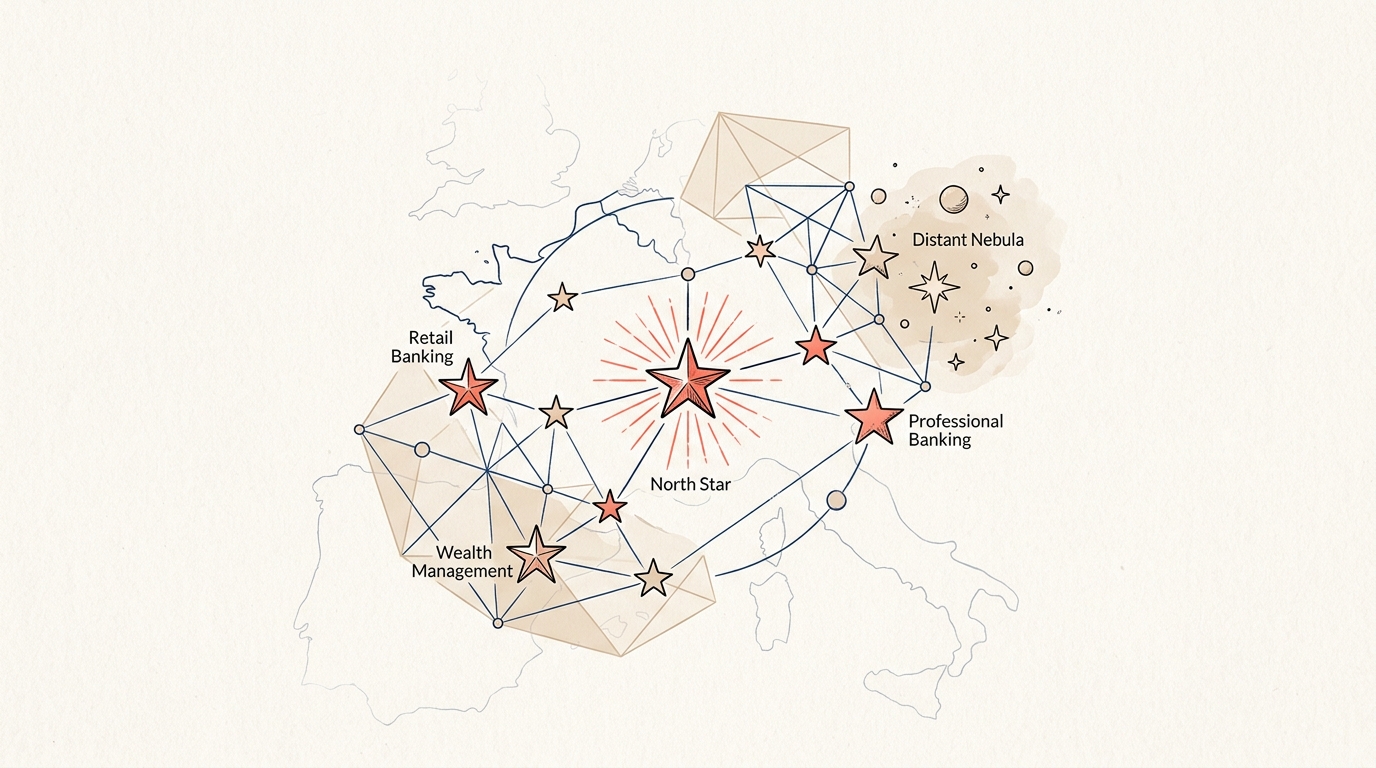
Create one cross-cutting frame that can guide retail, professional and wealth-management targets without flattening their differences.
Test naming against architecture
Compare standalone, endorsed and descriptive naming options through the service model they require.
Hand over decision rules
Equip teams to manage future edge cases consistently across brands and countries.
Research and work conducted
What the engagement covered
- A map of needs and life moments supporting allocation between the two brands.
- An explicit definition of each brand's role and boundaries.
- A cross-cutting segmentation principle and business-specific target definitions.
- Naming options for the European offering and their service-model implications.
- A service architecture identifying what had to be comparable across France, Belgium and Italy.
- A decision framework for cases not anticipated by the initial work.
Business value
A reading that makes trade-offs easier

Paying once, not twice
Explicit roles reduce acquisition spend on the same customer across sister brands.
Designed movement
A customer can move between brands as needs evolve when the journey is intentionally designed.
Shared language
One segmentation principle allows teams across three businesses to compare, learn and build coherent journeys.
A name that can be delivered
Naming derived from service architecture avoids a European promise contradicted by experience.
Deliverables
Objects teams can use beyond the engagement
- A map of customer needs and life moments.
- Brand roles and allocation boundaries.
- A segmentation principle spanning three banking businesses.
- Target definitions by business.
- European naming options with service-model implications.
- A service-model architecture and reusable decision frame.
Key learnings
What this case makes clear
- Differentiating from a sister brand is an architecture question, not a communication question.
- Overlap is visible in customer journeys, not in positioning documents.
- Movement between brands over a customer's life is an asset when designed.
- A cross-cutting segmentation principle is more useful than three isolated frames.
- Naming is a consequence of architecture: chosen first, it can promise what the service cannot sustain.
FAQ
Frequently asked questions
What is brand architecture in a multi-brand group?
It defines the role, audience, boundaries and legitimate customer movement between brands so they create value together rather than compete internally.
Why is differentiating a sister brand different from differentiating a competitor?
A customer transferred within the group is not a net gain and can create duplicated acquisition cost. The question is allocation, not superiority.
Why does naming depend on service architecture?
A standalone European name implies comparable service across countries. If the experience differs, the name can create an expectation the service will contradict.
How can one segmentation principle work across banking businesses?
It supplies a shared logic while allowing retail, professional and wealth-management teams to use different target definitions rooted in their own decision realities.
What is invisible cannibalisation?
It is when sister brands appear distinct on paper but address the same people at the same moment with adjacent arguments.